- contact@insightxtract.com

Field notes on AI-powered document extraction — domain glossaries, reference data, agentic pipelines, and the path to straight-through processing.
The real problems teams hit automating submission and claims intake — and what separates a slick demo from production.
Every broker submits differently: mixed emails, ACORD editions, SOV workbooks, scans, one risk across many files. Template OCR assumes a fixed layout — and shatters.
The scariest failure isn’t an obvious one — it’s a plausible, well-formatted wrong value that sails through unreviewed. Why fluent models make confident mistakes, and what actually catches them.
Extracting a value is half the job. Making it consistent — dates, money, codes, conflicting values across documents — is the hidden tax that stalls every downstream system.
The moment a submission contains something off-script, legacy IDP stamps it ‘unsupported’ and dumps it on a human. That long tail is where automation quietly dies.
Many pilots demo well and never ship, because in a regulated line a black box can’t answer the one question that matters. Explainability, audit trails, and reproducible output.
Accurate extraction is the easy part. Getting data into the PAS, rating engine, and claims system — each in its exact shape, reliably, at scale — is where budgets die.
An even-handed framework for deciding whether to build submission extraction in-house or buy — and everything a naive ‘we’ll just call an LLM’ build underestimates.
Classic IDP was built for high-volume, fixed-layout documents. Submissions are the opposite: variable, multi-document, semantic. Where template IDP hits a ceiling — and how to tell you’ve outgrown it.
How the extraction engine works — agents, agentic pipelines, reasoning, and the data-quality guarantees behind every result.
Extraction answers the questions you knew to ask. Point at a submission or claim folder for the other kind — every answer carries the verbatim words it rests on, and clicking a citation opens the document at the page with those words boxed. Prepared once, answered in pennies, and exposed as a REST API for your own workstation.
Our chat cited the right words and highlighted a paragraph four inches above them. Three unrelated faults — a three-word anchor, a form quoted out of order, and a flex container stretched to the wrong size — and why a missing highlight beats a confident wrong one.
Most tools return whatever the model emits. See how every agent produces one canonical shape — dates as YYYY-MM-DD, money as bare numbers, percentages as ratios, booleans as Yes/No, null for not-found — guaranteed regardless of which model ran.
A number like 0.87 isn’t actionable. See how every field gets a standard category — exact, implied, inferred, or uncertain — emitted by the model and validated by the engine, so reviewers know exactly what to check.
Formatting and confidence standards set once at the platform level and inherited by every agent, with overrides only where justified. One admin page, no copy-paste drift, no redeploy to change.
A submission isn’t a flat list of 40 fields — it’s a graph of parties, places, coverages, and claims with real cardinality: parent plus subsidiaries, many locations, many claims. See how InsightXtract extracts into a typed, connected entity model that maps into your PAS.
“Apex Ins. Brokers” and “Apex Insurance Brokers LLC” are one broker. See how InsightXtract resolves extracted parties to a canonical identity — Broker #B-1024 — with a confidence score, so dedupe, write-back, and analytics work at carrier scale.
Carriers already file work in folders — year/insured/submission-id. See how InsightXtract reads that tree as run metadata (no re-keying) and writes structured results back to the source: SharePoint, cloud storage, or the policy system.
Your workbench or claims system posts a bundle of documents; the API detects the line of business, classifies, extracts, consolidates, and returns a structured record with citations and confidence — by poll or webhook. Embed extraction in your own automation.
In legacy IDP every new document type is a data-science project. In InsightXtract a business analyst builds an agent in an afternoon — upload a sample, let AI discover the fields, refine, bind glossaries, add rules, test, publish. All serialized to YAML the same engine runs.
Template IDP marks anything it doesn’t recognize “unsupported” and drops it on a human. See how InsightXtract routes unclassified documents through the same engine using project context as hints — so the long tail automates too.
A loss run, an ACORD, a financial statement each have conventions an expert applies by reflex. See how InsightXtract packages that as skills — focused, versioned playbooks with machine-checkable invariants, loaded only when relevant. Not prompt spaghetti.
“How did it decide that?” is the question that stalls AI pilots in regulated lines. Every extraction records an ordered, append-only trace of its reasoning — perceive, plan, extract, validate, re-extract, reflect — live and persisted for audit.
Most tools hand you their JSON and leave you to build glue code. InsightXtract inverts it — you declare the target record (fields, source priority, lookups, validation, provenance) and the agent conforms. One run, one governed record, many consumers.
We told the schema, in plain words, that directors and shareholders are different figures. It returned 84 for both — while the schedule beneath listed five directors. Four times a description failed and a deterministic rule fixed it. When to describe, and when to compute.
An extractor that hands you “Calif,” “$1,234.5,” and no total isn’t finished — it’s handed you a cleanup project. See how standardize, format, derive, and validate rules turn raw values into clean, checked, decision-ready data in the same run.
STP is only as good as the number it’s built on. See how grounded, field-level confidence lets a document clear automatically while its two shaky fields — and only those two — route to a human. Automation as an objective decision.
The full architecture — an agentic reasoning loop, an agent-of-agents for whole submissions, dynamic domain skills, a governance-first core, adaptive token models for cost, and provenance, guardrails & citations — that handles over-running tables, charts, badly scanned pages, mixed-language bordereaux, dynamic Excel and 300-page files. With examples throughout.
Legacy IDP runs one OCR pass and one prompt. InsightXtract runs a reasoning loop — it looks at the document, plans a per-field strategy, extracts, checks itself against your rules, re-extracts what failed, and scores its own confidence. A worked walk-through with the live agent trace.
Any tool returns a number and a score; the question is whether it can tell when the number is wrong. See how the agent validates a loss run must foot and a date must precede its expiry — then re-extracts only the failed fields before a human sees them. With worked invariants.
A typed policy number and a rubber-stamped date want to be read in completely different ways. See how the agent chooses, field by field, whether to read the text layer or look at the page image — faster, cheaper, and more accurate than OCR-everything.
A submission that argues with itself — three revenues, a fleet count that doesn’t match, a loss run that won’t sum. Six worked examples of how InsightXtract resolves each to the right value with a declared source-of-truth, flags rather than “fixes,” and attaches the reasoning to every answer.
A submission is an email, a few ACORDs, an SOV, and a loss run about one risk. Extract each once, cache it, consolidate into a single record — so a fix never re-runs the whole packet.
Where InsightXtract fits in the business — underwriting and claims workstations, FNOL, PAS, and API-first integration.
Behind a versioned Extraction API, submissions arrive pre-read, pre-validated, and cited — a panel in the desk underwriters already live in, not a detour away from it.
Pull the updated SOV, loss runs, and exposure data straight from brokers, extract them, and hand the underwriter a year-over-year delta — the renewal pack builds itself.
Email, ACORD FNOL form, API payload, or call transcript — every one becomes the same validated, coverage-aware claim record, routed to the right adjuster queue without retyping.
Validated submissions and FNOLs post straight into your PAS and claims platform, with output contracts and version-pinning keeping the mapping stable under a running system.
The submission extractor is an orchestrator — it classifies each document, hands it to the agent configured for that type, and consolidates the envelope into one clean record.
Each extraction agent is a scoped, version-pinnable API — so policy-admin, claims, and data platforms request the fields they need and write results straight to their own tables.
Connect intake, extraction, transformation, and delivery on one visual canvas — a broker submission email becomes validated JSON in your PAS and warehouse, no integration scripts.
Give each MGA its own configured agent, invokable by API key — it normalizes any layout into your treaty schema, validates it, and flags variance versus prior periods, at volume.
The controls that make automation trustworthy — auditability, separation of duties, versioning, evaluation, and human review.
A multi-division carrier can’t run on one flat config or a free-for-all. See how InsightXtract layers configuration and reference data with most-specific-wins resolution, role-based access, and draft/publish versioning — define once, override locally, change with control.
A detailed rubric for carriers, MGAs, and TPAs: the criteria that actually matter for automating submissions and claims at high accuracy with minimal human involvement — and the concrete problems that arise if you skip each one.
Reviewer fixes shouldn’t evaporate. See how corrections drive reviewer-approved, validated, versioned agent changes on ACORD 131 submissions — so the same P&C mistakes stop recurring.
Per-field provenance and bounding-box citations, old→new correction history, separation of duties, and versioned records — so every P&C extraction is defensible for exams, disputes, and reinsurance.
Separate the agent version from the output contract — so ops can ship a smarter ACORD prompt every month without a downstream system pinned to a stable schema ever noticing.
Role-based access keeps the reviewer who corrects extracted data from quietly rewriting the agent that produced it — so a correction stays a correction, never a hidden model change.
Most tools have a review step; few feed what the reviewer learns back to the agent. Turn each correction into tuning fuel, so a recurring mislabel gets fixed once and prevented at source.
Automation is not about removing people — it is about aiming them. Automate the clean majority, route the uncertain by confidence, field by field, so accuracy and throughput both hold.
Lower cost per submission, minutes instead of days, and more capacity from the same team — here is how the STP math actually works for underwriting intake.
The insurance domain knowledge behind accuracy — document classification, glossaries, lookups, and master data.
How InsightXtract classifies P&C documents by what they do, not what they look like — 23 classes across 7 severity bands, an evidence-bearing verdict, the normalize→route→vote→resolve pipeline, and how that one signal drives claims triage, compliance clocks, underwriting intake, and any downstream system.
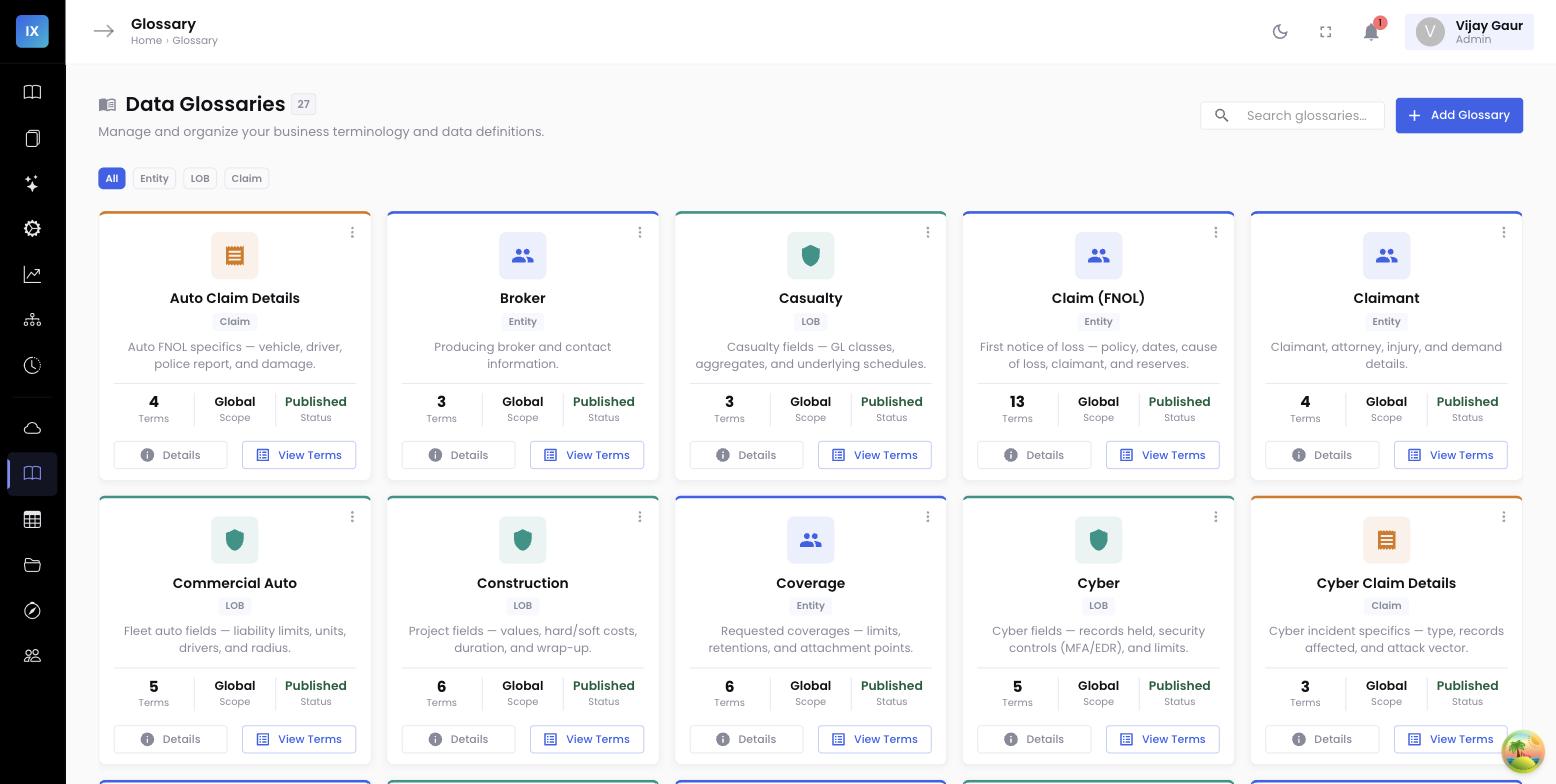
Every submission speaks a different dialect. See the P&C glossary library and how business terms ground the extraction agent — definitions, sample values, and canonical field names.
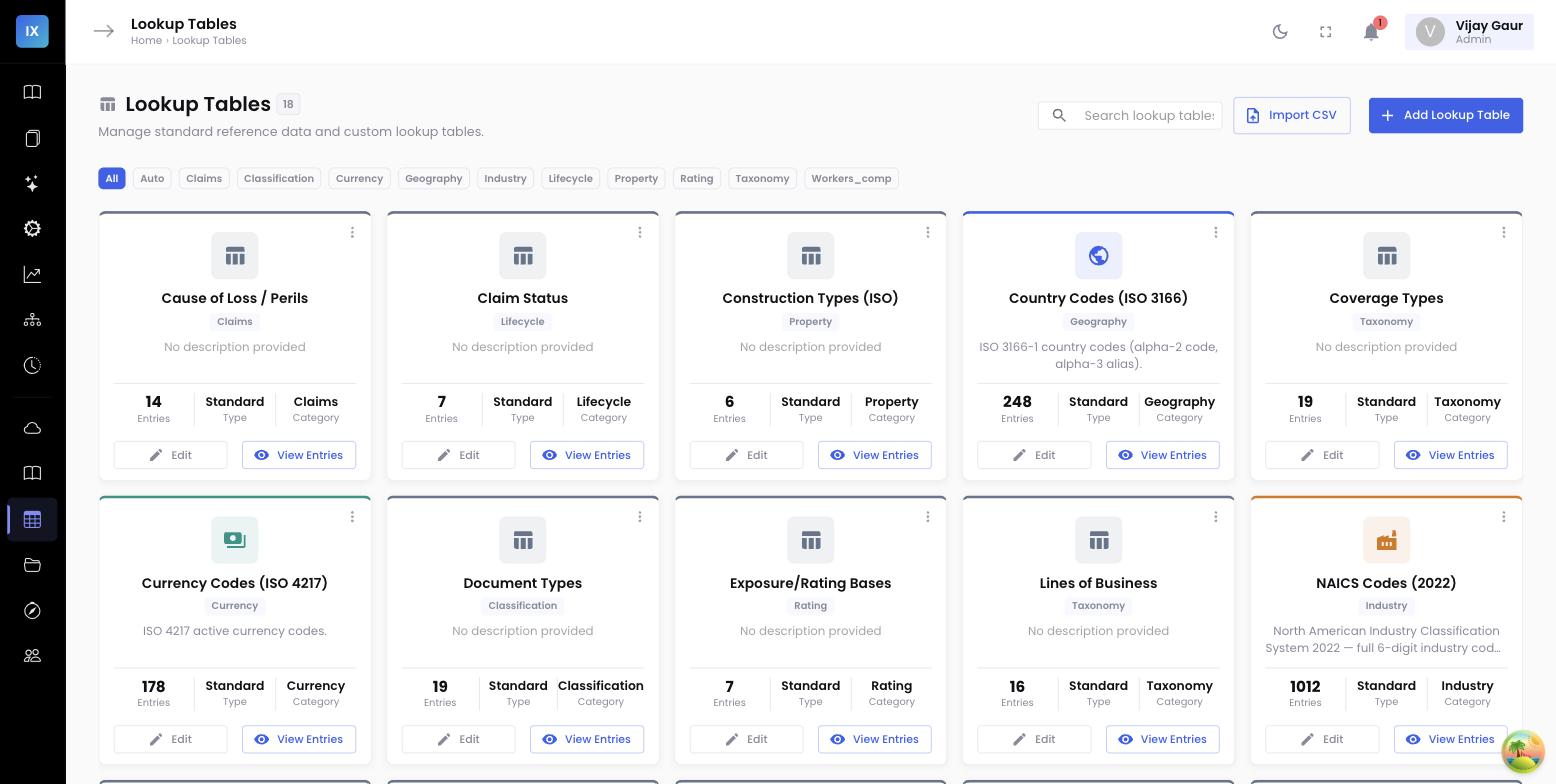
Standardize values to NAICS/SIC/ISO codes and resolve Insured & Broker names against MDM master data — so extraction feeds clean, keyed records into downstream pipelines.
Segment by segment — every document in a management-liability submission and what it covers, across D&O, EPL, Fiduciary, Crime, K&R and professional lines.
A field-level guide to a private-company ML packet — the broker email, the application and its supplements, audited financials, loss runs, ownership and board schedules — and the D&O, EPL, Fiduciary, Crime, K&R and Misc PL coverages each one feeds.
Trustees, volunteers, donor-restricted net assets and grant funds change the risk. The full nonprofit ML document set — the Not-for-Profit application, nonprofit financial statements, plan and loss schedules — and the coverages behind each.
Securities claims define public-company D&O. The document set — SEC filings (10-K, 10-Q, proxy, 8-K), the excess tower and Side-A DIC, market data — and the Side A/B/C coverage structure each one informs.
Banks, advisers, broker-dealers and funds — regulator- and AUM-driven. Call reports, Form ADV, prospectuses and the financial-institution bond, plus the professional-liability and E&O coverages at the center of the risk.
Field-by-field, line by line — the coded, cited record InsightXtract produces from each type of submission.
Inland marine covers property that moves. See how a broker email and application become one coded record — coverage form, limits, and the equipment, transit, and loss-history schedules row by row.
A BOP looks simple, but the price turns on building values, protection class, per-location construction, and a clean loss run. See it all turned into one coded, cited record.
Equipment Breakdown turns on what mechanical/electrical/pressure equipment runs, and the interruption when it fails. See the object schedule and loss history extracted into one coded record.
A recall submission is just an email and an application, but the risk hides in the detail — products profile, coverage tower, per-product schedule, and prior-recall history.
Surety is a credit decision in disguise. See how a bond application becomes one coded record — principal, bond type, obligee, schedule, and claims history, bond types standardized to a glossary.
A Tech & Misc E&O submission is an email and an application — but the risk lives in the service mix, the claims-made trigger, and the claims history. Every field, coded and cited.
The price lives in the disciplines, billings, claims-made retro date, project mix, and prior claims. See every field InsightXtract extracts from an A&E submission.
A marine cargo application hides a lot. See the cargo profile, per-conveyance and per-location limits, war/SRCC terms, the route-by-route conveyance schedule, and loss history — one coded record.
Value at completion, hard/soft costs, construction type, term, and the per-project schedule decide the price. See every field InsightXtract extracts from a builders risk submission.
The account looks like one number — total insured value — but the risk lives in the schedule. See how the SOV workbook, application, and broker email become one coded, COPE-aware property record.
Primary GL is class-rated, so the price is only as good as the exposure basis behind it. See the fields, the exposure-by-class schedule, and the loss run pulled from every submission.
A fleet submission is a packet, not a document. See how the broker email, application, vehicle schedule, driver roster, and loss run become one coded, cited underwriting record.
Broker email, ACORD app, a payroll-by-class-code workbook, and a loss run — turned into one coded, cited record. And why payroll-by-class is the price.
A cyber submission is just an email and an application, but the price hides in the controls. See every parameter pulled — records exposure, MFA/EDR/backups, ransomware sublimits — and why each moves the price.
The risk lives in the detail: the practice mix, the claims-made retro date, every attorney’s seniority, and the firm’s own claims history. See how it becomes one coded record.
Compact but dense. See how the broker email and med-mal application become one coded record — specialty and provider mix, claims-made coverage, the provider schedule, and claims history.
A site pollution submission becomes one coded record: the insured and operations, PLL/CPL limits and retro date, the per-site tank and remediation schedule, and claims history.
A real fire & life-safety contractor: classification, a complex 8-entity master supplemental (operations mix, occupancy split, systems detail), and the roll-up derivations — extracted, typed, normalized and cited on the same Excess Casualty agent.
A real 55-property portfolio: classification, an SOV and GL/WC schedules, a premises-driven loss run, and the schedule of underlying — extracted, normalized, and rolled up with citations.
A real products manufacturer: GL by products class, plant SOV and WC schedules, a products/WC loss run, and the tower — extracted, normalized, and rolled up with citations.
A real 28-facility health system: facility SOV, GL and clinical-WC schedules, a premises/WC loss run, and the tower — with professional liability coded separately.
A real oilfield-services contractor: GL by energy class, yard/site SOV and field WC, a pollution/auto/WC-heavy 42-claim loss run — extracted in full at a 64K output budget.
A real regional authority: municipal GL and WC schedules, a facility SOV, a law-enforcement/auto-heavy 44-claim loss run, and the tower over a self-insured retention.
Trucking excess is auto-driven. A worked example on a real motor carrier: classification, the fleet exposure workbook (vehicle schedule, drivers, WC payroll, terminals), the auto-heavy 5-year loss run, and the schedule of underlying — extracted, normalized, and rolled up with citations.
Carrier PDFs, Excel with stacked claim-identity headers and grouped Loss/ALAE/Total reserves, five years across GL/Auto/WC. How InsightXtract extracts every claim, normalizes status and cause, and rolls up incurred by line — with citations.
Underwriters price on totals, but the detail lives in hundred-row schedules. Why declarative sum/count/group_by rules on the document type beat prompt-arithmetic and hand-mapping — exact, reproducible, fuzzy to broker wording, with no fabricated zeros.
Payroll by class, vehicle schedules, SOVs, contractor WIP with stacked group headers — where naive extractors fail. How InsightXtract reads every sheet, flattens grouped headers, maps to typed schedules, normalizes codes, and derives header exposures exactly.
You can't price a layer without seeing the tower beneath and beside it. Extracting the schedule of underlying, the excess structure, and the full carrier-issued layer policies — attachment, limits, follow-form, endorsements — into one coded tower view.
A full worked example on a real contractor submission: classification, field & schedule extraction with page-level citations, glossary-normalized codes, deterministic derived exposures, and one governed underwriting record — with sample results shown throughout.
A comprehensive walk through the fourteen categories of data pulled from an excess/umbrella packet — ACORD, exposure workbook, vehicle schedule, SOV, five-year loss runs, underlying tower — the current-plus-prior-year time series, and why each parameter moves the price.
First notice of loss is a pile, not a form. See how InsightXtract classifies a claims packet and consolidates it into one coded claim record — with deterministic reserve inputs and citations.
A real commercial-auto collision packet — broker email, ACORD 2 loss notice, police report and repair estimate — classified, extracted with citations, coded against claims glossaries, and rolled up into one claim record with the reserve inputs computed exactly.
A real lifting-injury FROI packet: classification, injury extraction with citations, NCCI-aligned coding of body part / nature / cause, OSHA and lost-time flags, and an exact medical-billed roll-up — one governed claim record.