
There is a quiet failure mode in most document-AI projects. The extraction works, the accuracy is good, the pilot is a success — and then the data still lands in a spreadsheet that someone re-keys into the policy-admin system by hand. All that automation, and the last mile is still a person retyping. The value of extraction is only realized when the validated record lands in the system of record — the PAS for a submission, the claims platform for an FNOL — automatically, and stays landing there reliably as both systems evolve.
InsightXtract treats that last mile as the point of the whole exercise. A pipeline extracts, validates, shapes the result to a stable output contract, and delivers it into your PAS or claims system as a real record. And because the contract is versioned and the agent is version-pinned, the integration your architecture team builds once keeps working — the mapping does not shift when the extraction logic improves.
The path a record takes
From the pipeline’s perspective, delivery is the final leg of a run: extract, conform to the output contract, then hand off to the system of record. The sequence below is the same whether the destination is a Guidewire- or Duck-Creek-style PAS or a claims platform.
sequenceDiagram
    participant P as InsightXtract Pipeline
    participant X as Extraction Agent (pinned)
    participant PAS as PAS / Claims System
    participant DB as System-of-Record DB
    P->>X: Run extraction on validated packet
    X-->>P: Fields conformed to output contract v2
    P->>PAS: Webhook / DB write (contract v2 payload)
    PAS->>DB: Create submission / FNOL record
    DB-->>PAS: Record ID
    PAS-->>P: 201 Created (record ID)
    Note over P,PAS: Agent + contract are version-pinned,
so the PAS field mapping never breaks
The note on that diagram is the whole architectural promise. The PAS was integrated against output contract v2. As long as the pipeline delivers v2, the mapping the PAS team built holds — regardless of how many times the extraction agent underneath is improved and re-promoted.
The output contract: a stable shape, decoupled from the agent
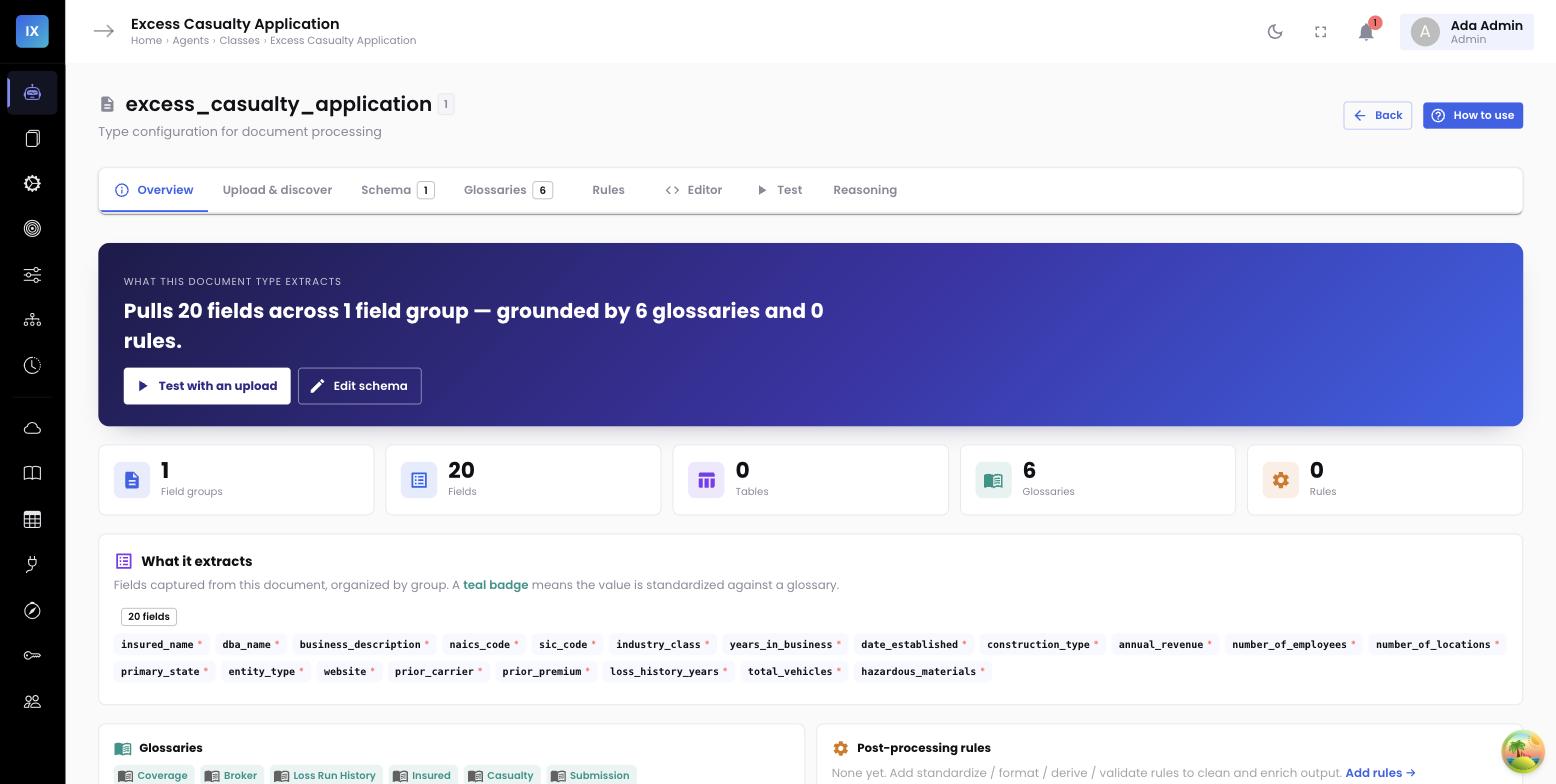
An output contract is the promise the pipeline makes to the receiving system: these field names, these types, this structure, every time. It is deliberately separated from the extraction agent. The agent’s job is to get the values right from messy documents; the contract’s job is to present those values in the exact shape the PAS expects.
This separation is what makes stability possible. When your extraction team improves the submission agent — a sharper prompt for the named insured, a new rule for premium conflicts — they change how values are found, not how they are shaped for delivery. The contract stays v2, so the PAS keeps receiving named_insured, fein, and requested_limits in the positions it was built to read. Improvement on one side; stability on the other.
A real P&C example: a cleared excess-casualty submission into the PAS
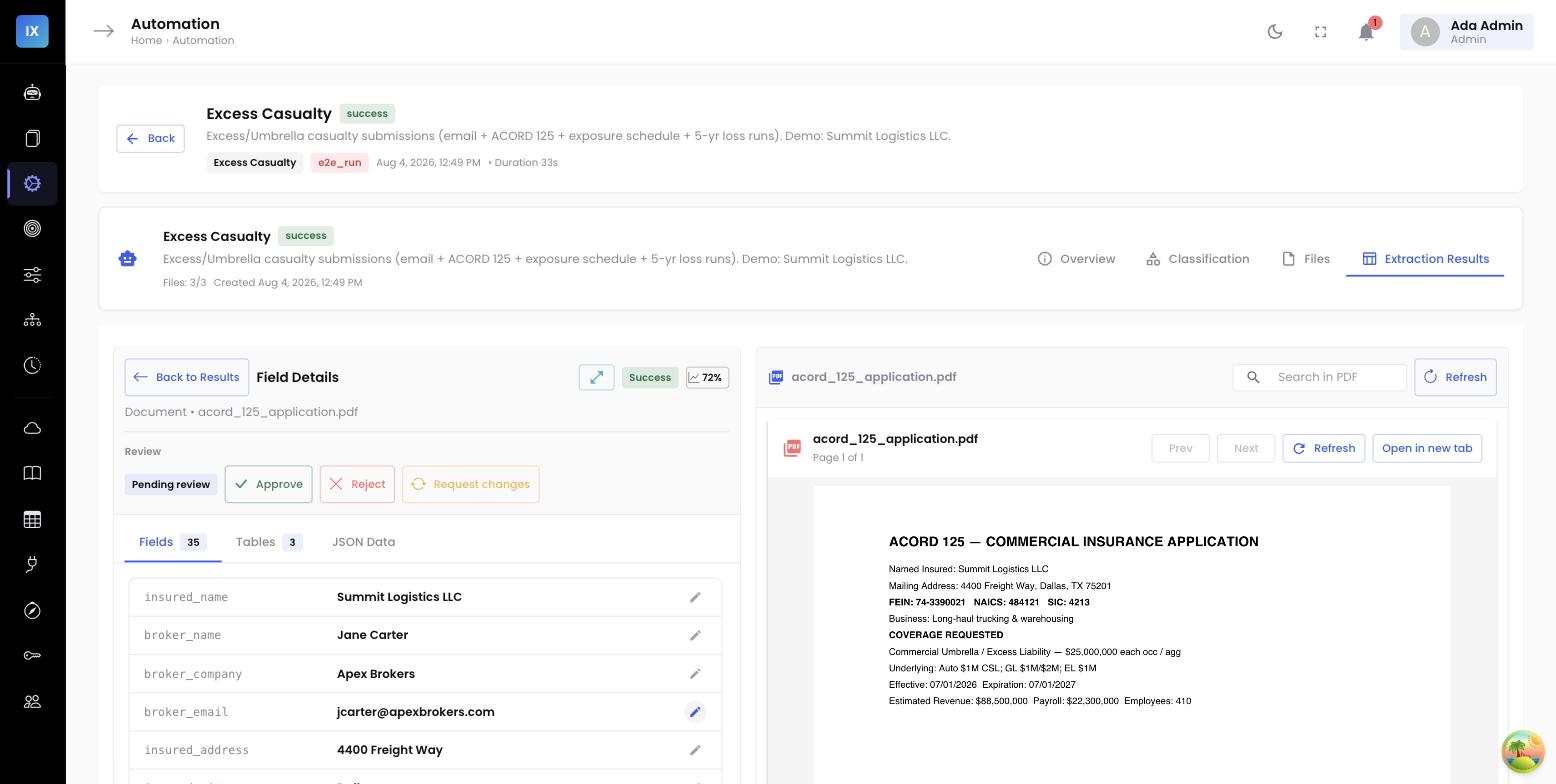
Consider an excess-casualty submission that has cleared and been through the intake pipeline. Confidence is high, the FEIN validated, and a human has signed off on the two fields that needed a look. Now the record has to become a submission in the PAS.
The delivery node posts the contract-v2 payload to the PAS submission API. The PAS creates a new submission for Summit Logistics LLC, populated with the named insured, FEIN, requested $25M per-occurrence and aggregate limits, the target effective date, and the underlying-limits schedule as structured line items — not as a PDF someone still has to read. The loss runs and the ACORD 131 that came in the packet are attached to the submission as parsed, structured data, so the underwriter opens a fully-populated file rather than a stack of documents to key.
What used to be a twenty-minute setup task — create the shell, re-key the header, transcribe the underlying schedule, attach the files — is now a record that already exists, complete, when the underwriter first opens it.
The same pattern for claims: an FNOL into the claims system
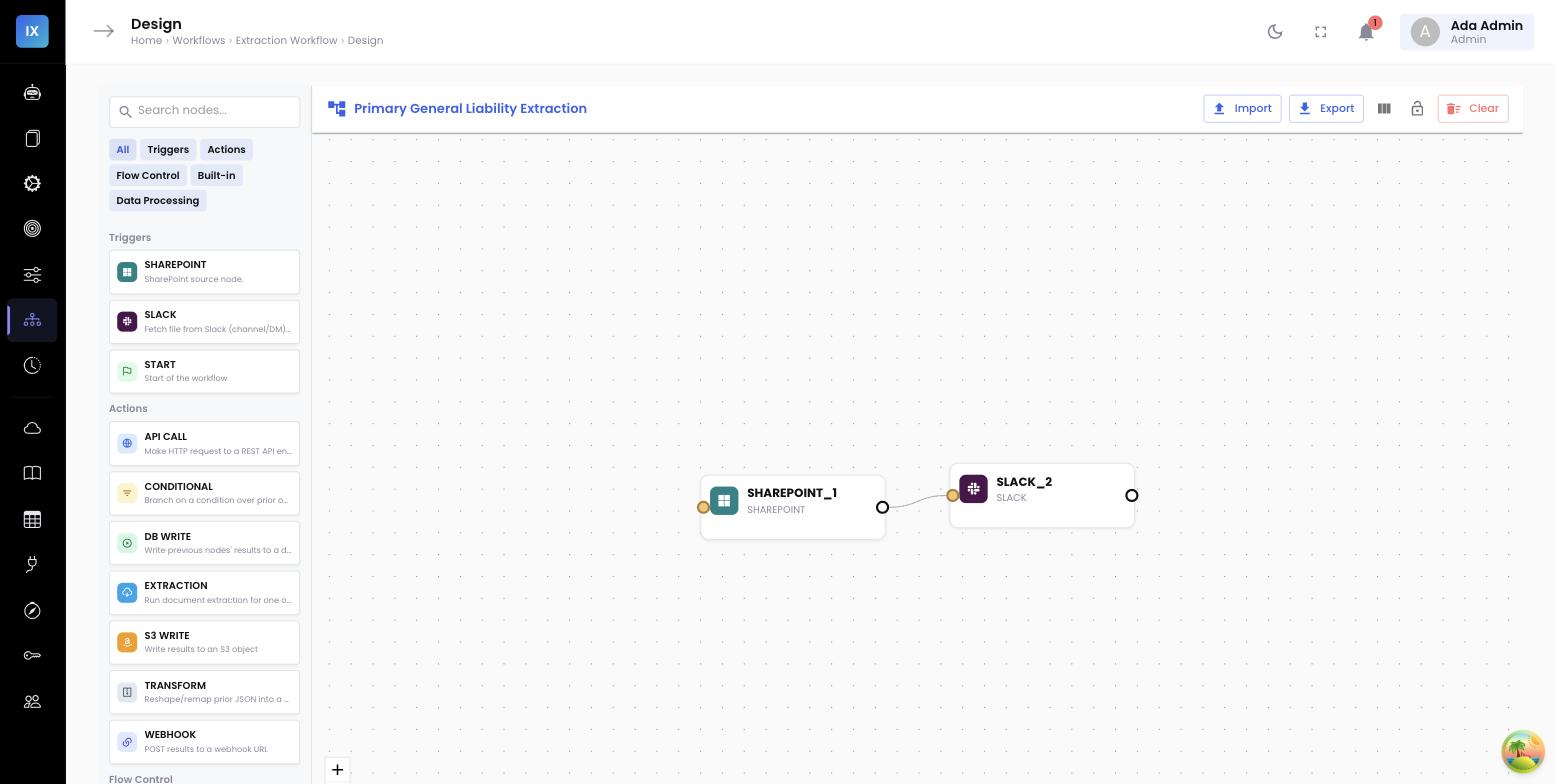
Straight-through delivery is not just an underwriting story. A first notice of loss arrives — an ACORD loss-notice form, or an adjuster’s email describing an auto accident. The claims pipeline extracts the claimant, the policy number, the date and location of loss, the loss description, and the reported reserve, validates the policy number against the in-force book, and posts the result to the claims system under a claims-specific output contract.
The claims platform creates the FNOL as a new claim, routes it to the right adjuster queue by line of business, and attaches the original loss notice as parsed data. The clock on the claim starts the moment the notice arrives — not hours later when someone gets to the intake queue. Same architecture as the submission path: extract, conform to contract, deliver into the system of record, keep it stable with version-pinning.
Why version-pinning is non-negotiable at this layer
A PAS or claims integration is expensive to build and painful to debug when it silently breaks. Pinning the agent version and the output contract means an extraction improvement can never change the payload shape a live integration depends on. You upgrade on purpose, with a test, never by surprise.
Delivery you can prove happened
Landing a record automatically is only trustworthy if you can prove it landed. Every delivery is logged: which run produced it, which agent version and output contract were used, the exact payload sent, the endpoint it went to, the response code, and the record ID the PAS or claims system returned. When finance reconciles, or an auditor asks “show me that this March submission was created by the system and by which version,” the answer is one row in the delivery log with the 201 Created and the returned record ID.
The same log is your early-warning system. If the PAS API starts returning errors after a release on their side, the delivery log shows the failures immediately, with the payload that was rejected — so you diagnose a mapping drift in minutes instead of discovering a week of missing submissions later.
Why this matters to a CIO
- The last mile is closed. Validated records land in the PAS and claims system automatically — no spreadsheet hand-off, no re-keying, so the value of extraction is actually captured.
- Integrations that do not break. Output contracts and version-pinning decouple extraction improvements from delivery, so a live PAS mapping keeps working while the agent underneath gets better.
- Deliberate upgrades. Moving from contract v2 to v3 is an explicit, tested decision your team makes — never a silent shape change that surprises a downstream system.
- Provable delivery. Every record posted is logged with its version, payload, response, and the record ID returned — supporting reconciliation, audit, and fast diagnosis when a downstream system changes.
Related: how the records get there →
Straight-through delivery rides on a visual pipeline. See from inbound document to your system of record, no glue code for how intake, extraction, and delivery are wired together without custom integration code.