- contact@insightxtract.com

Agentic extraction that classifies, validates, and improves — not just OCR.
For submission and claims intake — with built-in validation, full auditability, and your choice of straight-through processing or underwriter-in-the-loop review.

Deployed by P&C teams across
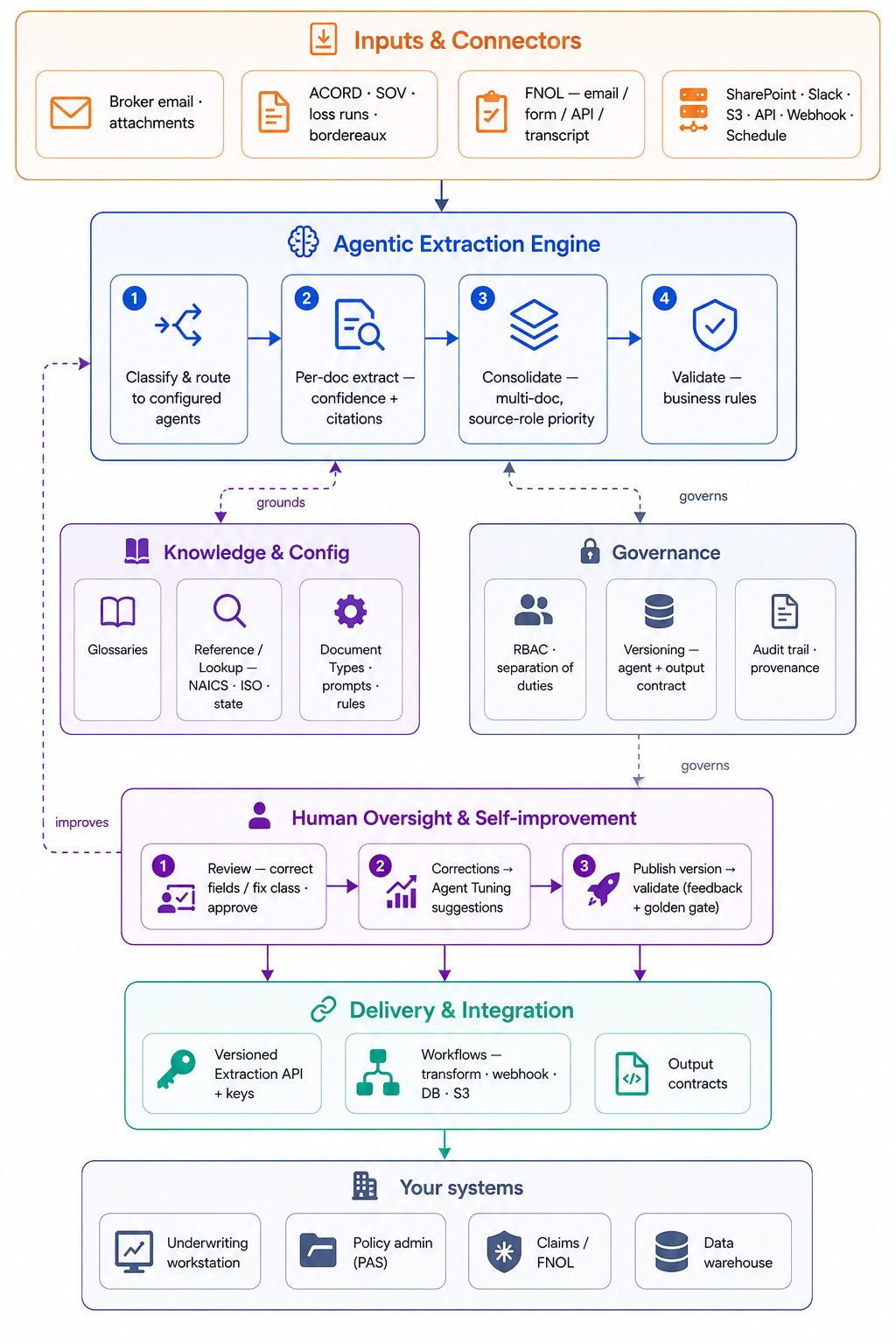
Most extraction tools stop at OCR. InsightXtract runs an agentic pipeline — extract, validate, decide — with auditability baked into every step.
Layout-aware extraction across structured forms, semi-structured loss runs, and free-text emails — with per-field confidence scoring.
Multi-step pipelines: classify the document, extract the schema, run business rules, cross-check against systems of record, escalate if needed.
Configure per LOB, per document type, per confidence threshold. Fully automated where the data is clean; underwriter review where it isn’t.
Governance, human oversight, and continuous improvement built in — so every extraction stays reviewable, controlled, and gets better over time.
Point at a folder in SharePoint, a mailbox, or your own bucket and ask it anything — with the verbatim words behind every answer.
Reviewers correct extracted fields and fix document classifications with a reason, then approve, reject, or request changes on a run.
Accumulated corrections are analyzed into suggested prompt, rule, and class-description changes for a reviewer to approve.
Role-based access — Admin, Builder, Operator, Reviewer, and Viewer — so each role sees only what it needs.
Invoke agents from other systems through a versioned Extraction API with scoped, version-pinnable API keys.
Visual pipelines chain extraction with transform, conditional, webhook, database, and S3 steps.
Agent and output-contract versions with per-field provenance and a full audit trail across the pipeline.
Build agents, measure accuracy on gold datasets, review only the exceptions, and let corrections tune the agents — all in one place, deployable in your own cloud.
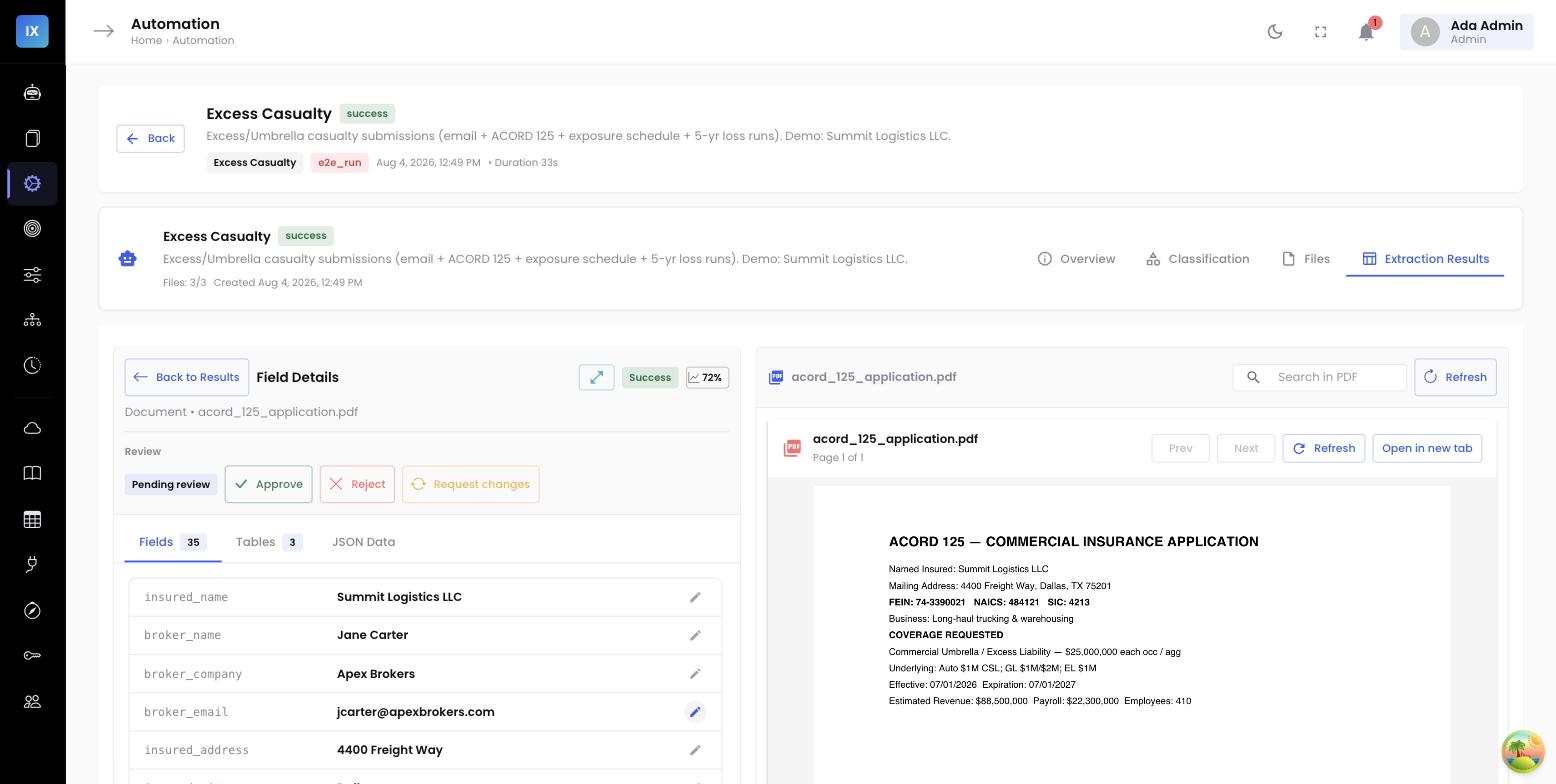
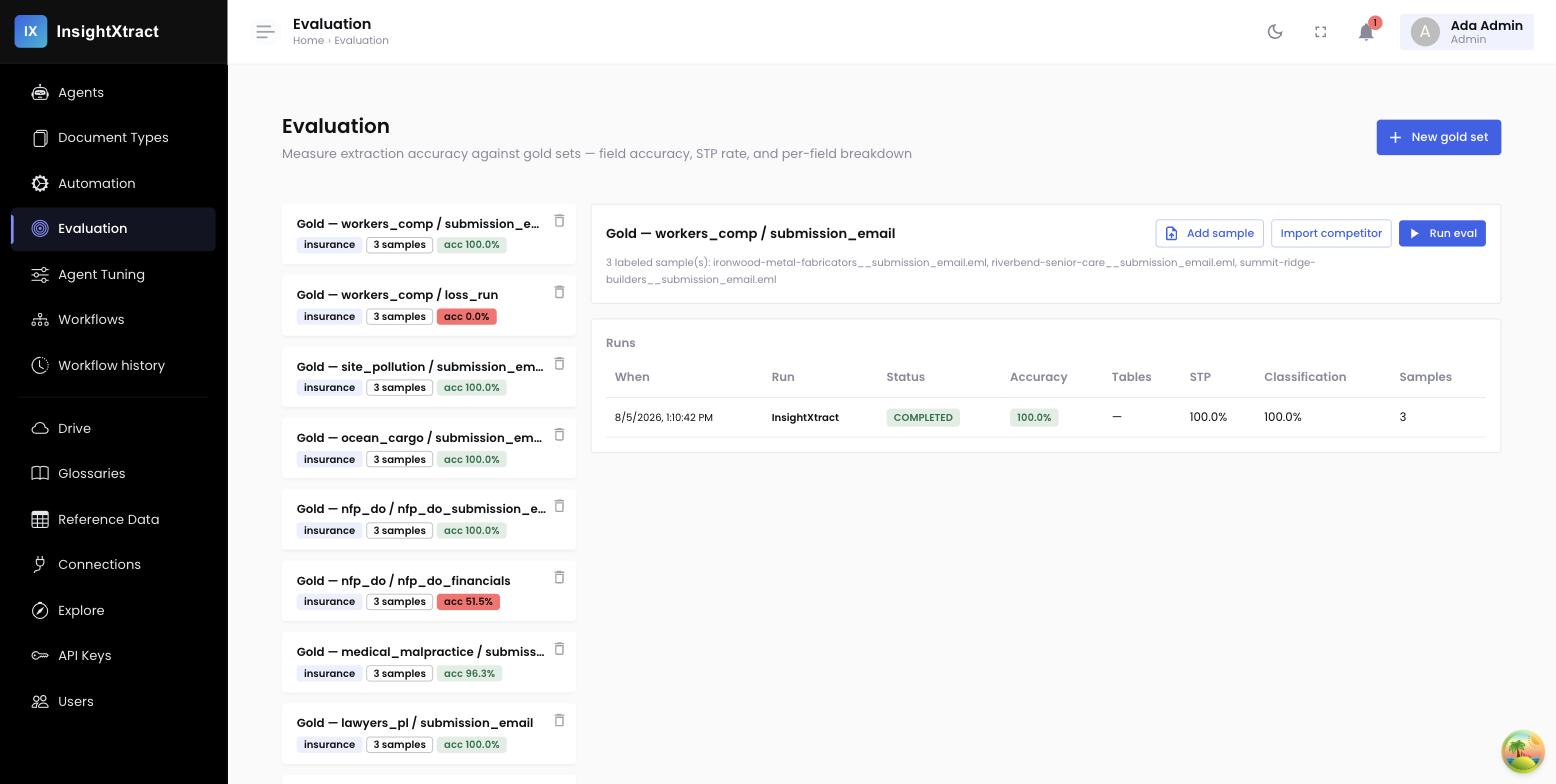
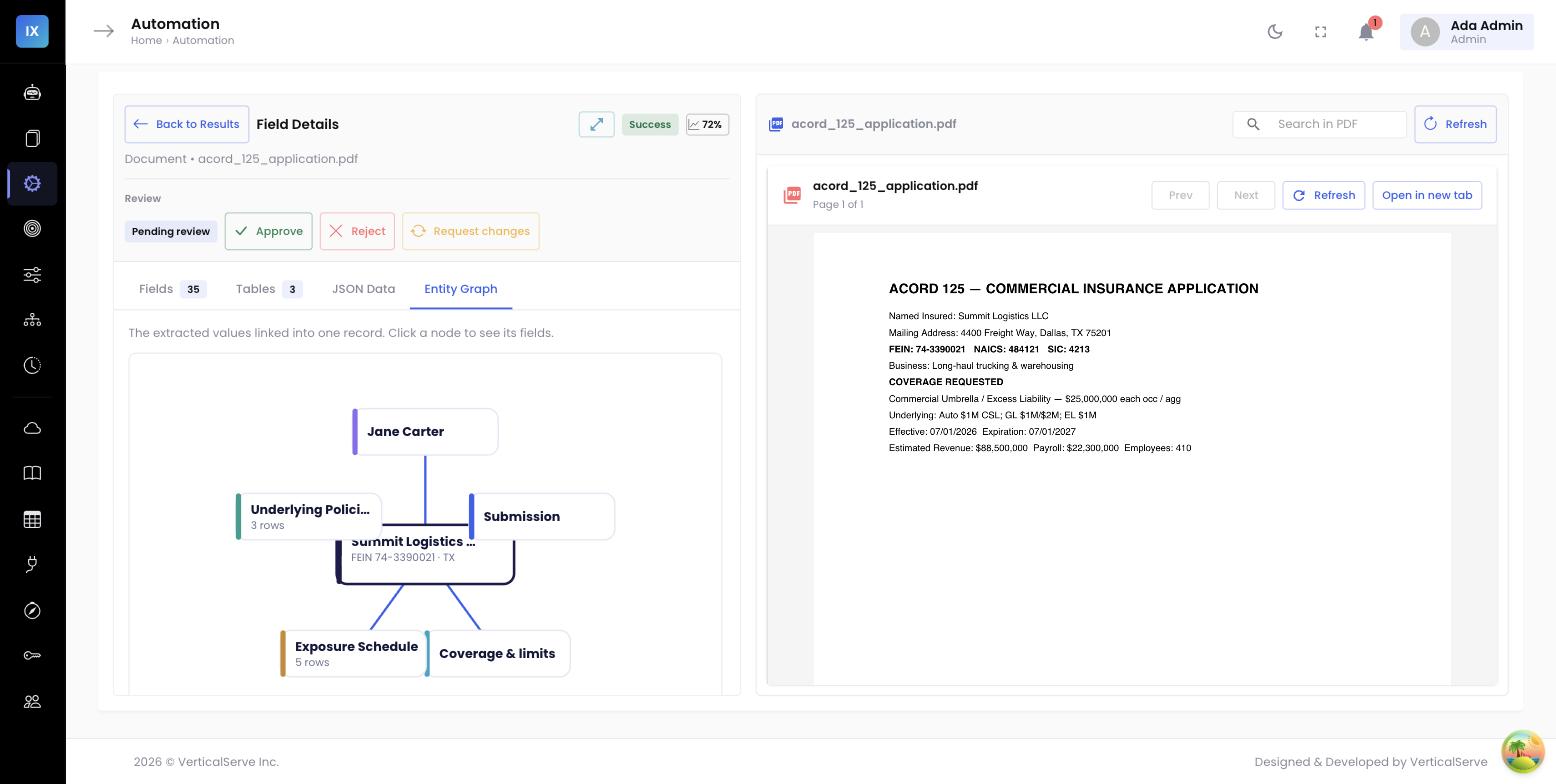
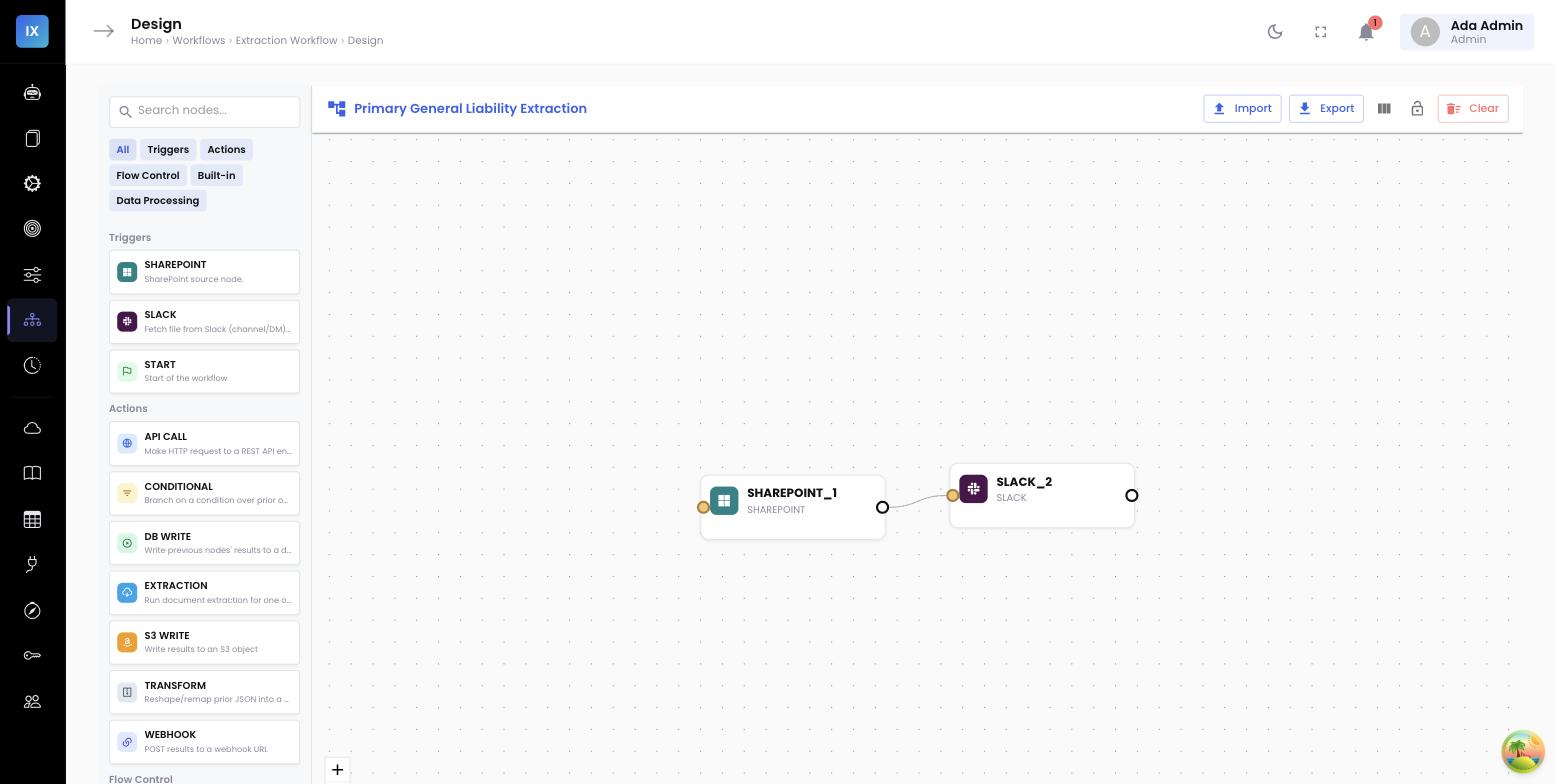
Each pipeline is a starting point — carrier-specific rules, LOBs, and routing get configured in the first sprint.
From inbound broker email to triaged submission packet in your PAS — with all attachments parsed, validated, and routed.
First Notice of Loss from any channel — phone transcript, broker email, FNOL form, partner API — into a structured, validated claim record.
Pull updated SOVs, loss runs, and exposure data from brokers and partners — with diff against last year for the underwriter.
MGA bordereaux ingestion at scale — premium, claim, and aggregate bordereaux normalized to your treaty schema.
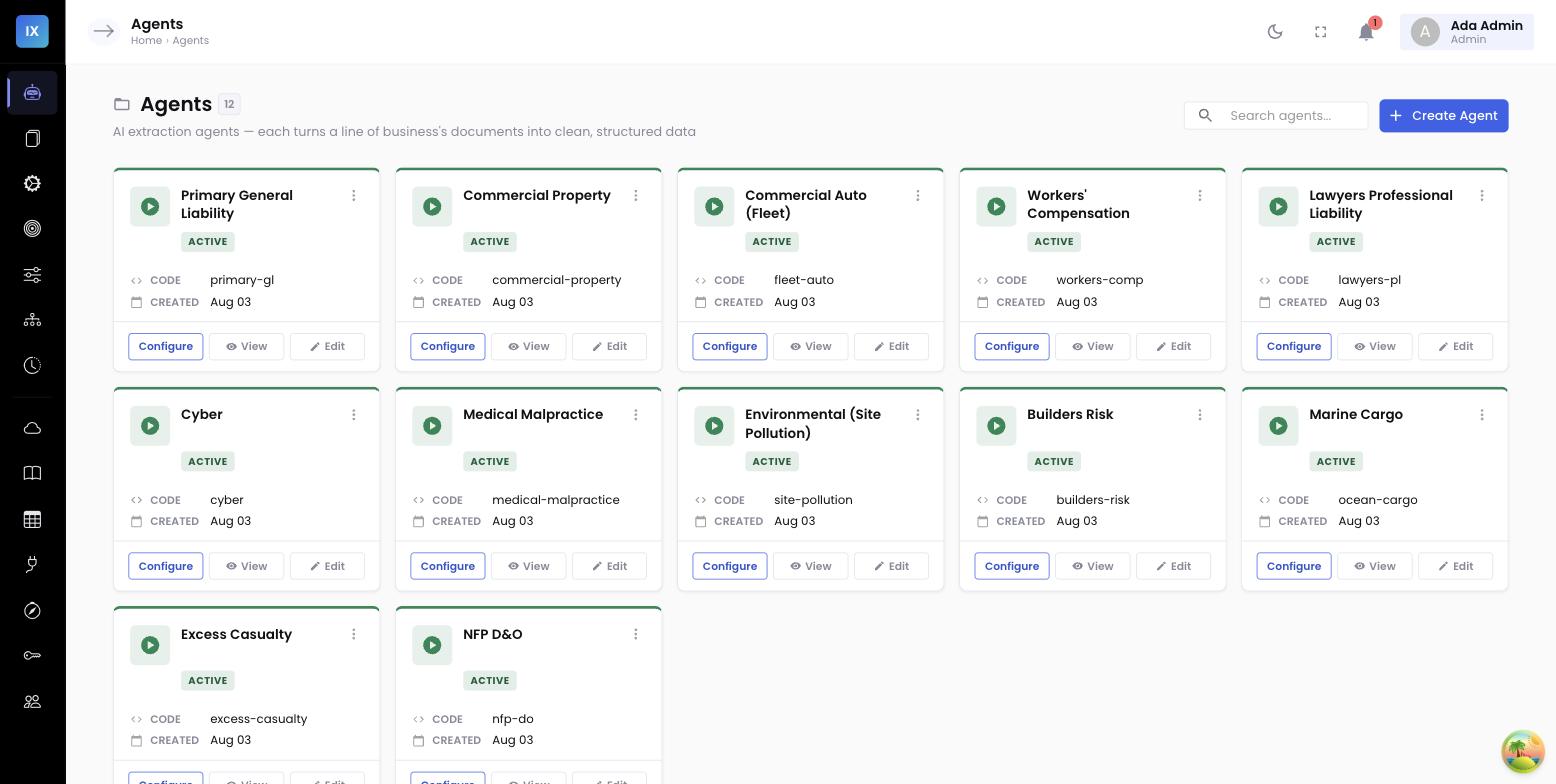
Purpose-built extraction agents per line — each capturing the submission’s full detail: exposures, schedules, loss history, and coverage terms. New lines are configuration, not a rebuild.
Don’t see your line? New agents are authored from field definitions, glossaries, and reference data — typically live in days.
Not a generic OCR plus regex. Pre-trained on real P&C documents, with schemas your team can extend.
All major ACORD templates with field-level schema mapping — ACORD 125, 126, 130, 131, 137, 140, and more.
Any carrier’s loss-run format — tabular, PDF, scanned. Normalized to a unified loss schema.
Statements of Value, exposure schedules, premium bordereaux — messy Excel turned into clean per-location records.
Free-text email bodies parsed for intent, named coverages, and embedded data. Attachments routed automatically.
FNOL packets, police reports, medical records, repair estimates — structured into claim records.
Your own underwriting questionnaires, supplemental apps, MGA-specific forms — trained on a few hundred samples.
Self-host in your cloud or data center. Pre-built integrations with the major P&C policy administration and claims systems.
Pre-built connectors for the major P&C platforms — Guidewire, Duck Creek, Sapiens, Insurity, EIS, plus broker portals and clearance systems. Custom integrations via the connector framework.
Architecture, key capabilities, and how InsightXtract compares across the P&C document-AI market — an 8-page executive brief for underwriting, ops, risk, and technology leaders.
Aggregated outcomes from P&C deployments. Numbers vary by LOB — we’ll size the ROI for your team on the discovery call.
Faster submission triage
P&C document types out of the box
Per LOB, per confidence threshold
Auditable per-decision provenance
What carriers, MGAs, brokers, and TPAs ask us first. More in our discovery call.
Out of the box: the major P&C ACORDs — 125, 126, 130, 131, 137, 140, plus dec pages and certificates. Custom variants and supplements onboarded in days from a few sample documents.
Yes — pre-built connectors for Guidewire, Duck Creek, Sapiens, Insurity, EIS, plus clearance systems and broker portals. Custom integrations via the connector framework if you run something internal.
Both, configurable per LOB and per document type. You set confidence thresholds and business-rule trip-wires; everything above threshold goes straight through, anything below routes to a reviewer queue with full document context.
Every extracted field with confidence, every validation rule that fired (pass or fail), every reviewer action (confirm, correct, escalate), every PAS write — with timestamps and user attribution. Exportable for internal audit and regulator review.
For variants of templates we already support (e.g., a carrier-specific loss-run format), usually 1–2 weeks from sample documents. For entirely new document types, 3–6 weeks including schema design and validation rules.
Self-hosted in your environment — cloud or data center. Documents, extractions, and review queues all stay inside your perimeter. HIPAA / GDPR / SOC 2-compatible deployments.
Field notes on P&C document automation, agentic pipelines, and ops-grade auditability.
A submission is a graph of parties, places, coverages, and claims — with real cardinality. See how InsightXtract extracts into a typed, connected model that maps into your PAS.
Every new document type in legacy IDP is a data-science project. Here it’s an afternoon in a six-tab builder — upload, discover, refine, test, publish. No code, no deploy.
You declare the target record — fields, source priority, lookups, validation, provenance — and the agent conforms. One run, one governed record, no downstream ETL.