
Medical malpractice — medical professional liability, or MPL — is a line where the details decide everything. Two practices with identical revenue can carry wildly different risk depending on the specialty of the physicians, how many of them are board-certified, which states they’re licensed in, and whether last year’s open claim is a nuisance suit or a seven-figure reserve. The submission itself is compact — a broker’s email with the ask and a medical malpractice application — but the information that actually rates the account is buried in a provider schedule, a claims table, and a set of coverage terms that only mean something in relation to each other.
Most intake tools read one document at a time and hand back a flat list of fields. That is not how an MPL account is underwritten. InsightXtract runs an agentic, multi-document pipeline that classifies each file, extracts to a per-document schema, consolidates everything into one unified account record, links it into an entity graph, and validates it against your rules and reference data — so the underwriter opens a single, coded, cited record instead of a stack of PDFs.
+ MPL application
provider schedule
claims history] --> B[Classify
each document] B --> C[Extract to the
right schema] C --> D[Consolidate
by source priority] D --> E[Link into an
entity graph] E --> F[Validate
rules + reference data] F --> G[One coded,
cited account record]
One submission, two documents, one connected record — classify, extract, consolidate, link, validate.
The idea that governs everything: specialty and providers are the price
Before the categories, the single most important concept. In medical malpractice, the exposure isn’t the entity — it’s the people and what they do. A ten-physician group tells you almost nothing; a ten-physician group where three are neurosurgeons and one is an OB/GYN is a very different risk from ten dermatologists, and the rate should reflect that. The same is true of coverage: an each-claim limit means one thing on an occurrence policy and quite another on a claims-made policy with a retroactive date that leaves a gap. So the extraction is built to capture the provider roster and the claims history as full tables, and the coverage terms as an interlocking set — not scattered single values.
In the tables below, the Type column flags how each parameter is captured:
- Point-in-time — a single static fact about the account.
- Current — a value for this term’s coverage or exposure.
- Per-row — a table: one provider, or one claim, per row.
A · Insured identity & legal structure
Who the account is — the contract party, its identifiers, and where the risk sits. Source: application form.
| Parameter | Type | Why it matters |
|---|---|---|
| Insured name · DBA | Point-in-time | The contract party and unique account key — drives clearance, conflicts, and de-dupe. |
| FEIN · entity type | Point-in-time | Federal ID and legal form — solo, group, PC/LLC, or facility changes how the policy is structured. |
| Address · risk state | Point-in-time | Venue is decisive in MPL — some states are far more plaintiff-friendly and carry tort-reform differences. |
| NAICS · SIC code | Point-in-time | Class-based rating and appetite/knockout — standardised against reference tables. |
B · Broker & submission
Who’s placing the account and the shape of the ask — the distribution chain and the transaction. Source: broker submission email.
| Parameter | Type | Why it matters |
|---|---|---|
| Broker name · broker email | Point-in-time | Distribution routing, binding authority, and correspondence. |
| Product | Current | The exact line being requested — med-mal / MPL — and the coverage form that follows. |
| Effective date | Current | Term start and the binding deadline — standardised to a canonical date. |
| Requested limit | Current | The capacity the broker is asking for — the headline of the ask, reconciled against the application limits. |
C · Entity & practice profile
The operational shape of the practice — what kind of medicine it is, at what scale, and with how many people. This is where MPL exposure is really defined. Source: application form.
| Parameter | Type | Why it matters |
|---|---|---|
| Business description · years in business | Point-in-time | Nature of operations and stability credit — a new practice underwrites differently from an established one. |
| Facility type | Current | Solo office, group clinic, surgery center, or hospital — drives the hazard band and the coverage form. |
| Primary specialty | Current | The single biggest severity driver — surgery and OB carry a far higher claim cost than primary care. |
| Physician count · number of providers | Current | The core exposure unit — MPL is largely rated per provider. |
| Annual patient encounters · annual procedures | Current | Volume of exposure — more encounters and procedures means more frequency opportunity. |
| Employee count · total payroll · estimated revenue | Current | Scale of operations and the secondary exposure base — standardised to currency for rating. |
D · Coverage & limits
The exact shape of the cover being requested. In MPL these terms only mean something together — the trigger, the retroactive date, and the tail decide whether the limit is real. Source: application form.
| Parameter | Type | Why it matters |
|---|---|---|
| MPL limit (per-claim / aggregate) | Current | The headline capacity — standardised to currency and reconciled against the requested limit. |
| Each-claim limit | Current | The most a single suit can recover — the primary severity cap. |
| Aggregate limit | Current | Total annual capacity across all claims — matters most for high-frequency specialties. |
| Claims-made vs. occurrence | Current | The coverage trigger — the fundamental structural decision in MPL that governs everything below. |
| Retroactive date | Current | On a claims-made policy, how far back prior acts are covered — a gap here is uncovered exposure. |
| Tail coverage | Current | Extended reporting for claims made after the policy ends — a major cost and continuity factor. |
| Prior carrier · premium | Current | Coverage continuity and the rate-change baseline — the price-to-beat on a renewal or move. |
E · The provider schedule — one row per provider
The heart of an MPL rating. InsightXtract reads the provider roster as a table — one row per physician or provider — because the mix of specialties, licenses, and credentials is what actually prices the account. Source: application form.
| Parameter | Type | Why it matters |
|---|---|---|
| Per provider: provider name | Per-row | Identifies the covered individual — the unit that carries the risk and the premium. |
| Per provider: specialty | Per-row | Per-provider severity class — the specialty mix drives the blended rate more than any single field. |
| Per provider: license state | Per-row | Venue exposure per provider — multi-state rosters spread the account across differing tort regimes. |
| Per provider: years experience | Per-row | A frequency signal — very new and very senior providers carry distinct claim patterns. |
| Per provider: board certified | Per-row | A credential and risk-quality marker that often earns a rating credit. |
F · Claims history — one row per claim
The single biggest pricing input after specialty. InsightXtract reads each claim as a row and standardises the financial values so the loss picture is comparable and computable. Source: application form.
| Parameter | Type | Why it matters |
|---|---|---|
| Per claim: claim number · date of loss | Per-row | Each loss’s identity and timing — date is standardised to a canonical format for trending. |
| Per claim: description | Per-row | The nature of the allegation — the qualitative signal of severity and escalation potential. |
| Per claim: status (open / closed) | Per-row | Open claims are live exposure still developing on the books. |
| Per claim: paid · reserve · incurred | Per-row | Cost to date, remaining exposure, and total incurred — standardised to currency for rollups and loss-ratio math. |
From two documents to one connected record
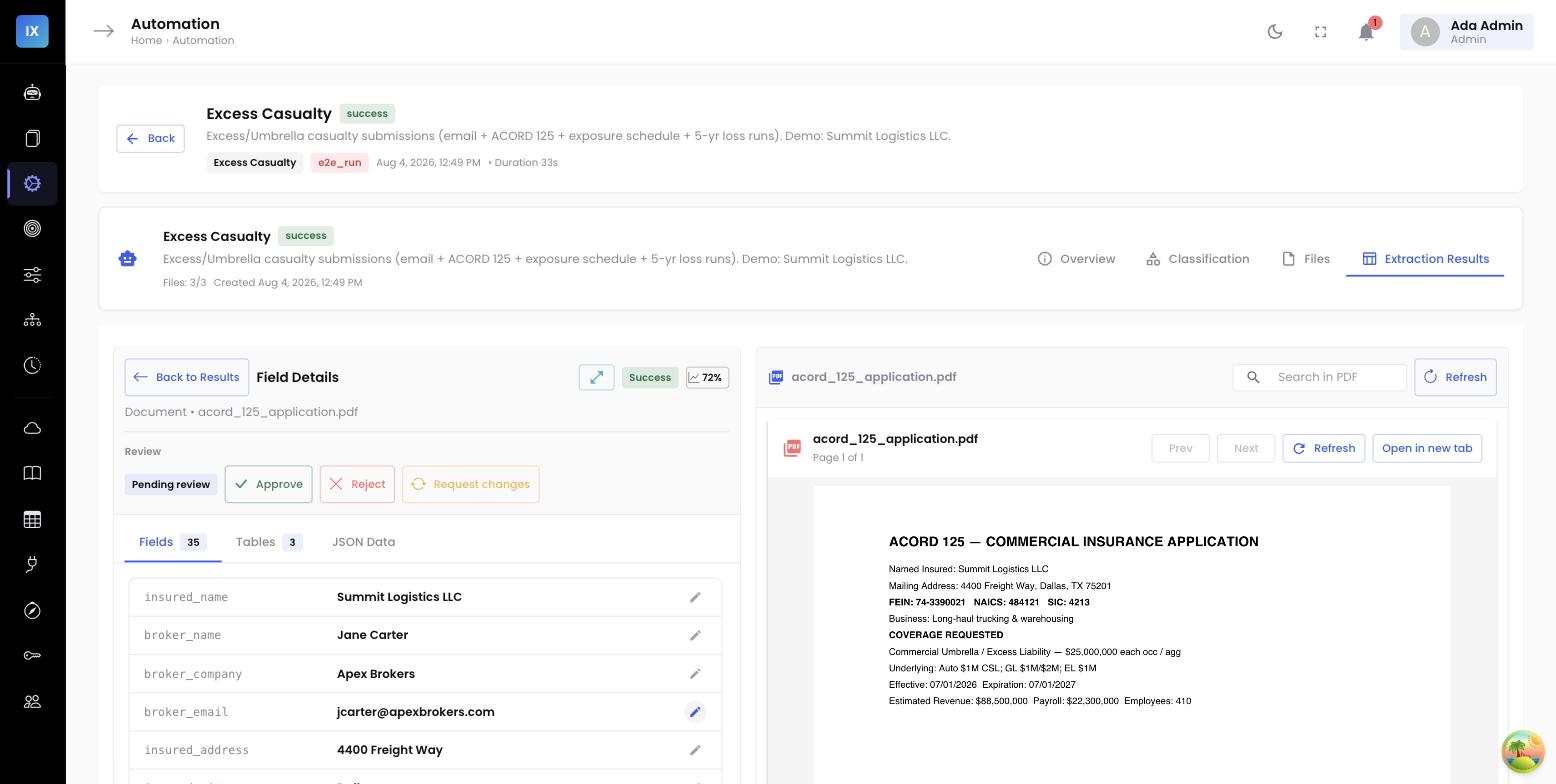
Pulling these parameters out of two documents is only half the job. The value is in consolidation: the insured named on the application, the broker on the email, the coverage terms, the provider roster, and the claims all describe one account. InsightXtract merges them into a single record by a declared source-of-truth priority — when the application and the email disagree on the insured name or the limit, the application-form value wins — and links the result into an entity graph: the insured at the centre, connected to broker, submission, coverage, the provider schedule, and the claims history. Every value is standardised against reference data — state codes and NAICS codes are validated against lookup tables, currency and date fields are normalised — and each field is cited back to the page it came from.
Why the graph, not just a form
An underwriter doesn’t think in flat fields — they think in relationships: does the specialty mix on the provider schedule line up with the limits being requested? Does the retroactive date leave a gap the prior carrier used to cover? Does the claims history concentrate on one provider or one procedure? The entity graph makes those connections explicit and clickable, with every value cited back to the page it came from.
Why it matters to the business
Comprehensive, structured extraction of an MPL submission isn’t a data-entry nicety — it changes the economics and quality of the book:
- Specialty is severity. Capturing the primary specialty and the per-provider specialty on the schedule lets you rate to the real hazard mix instead of a single blended guess — the difference between a priced surgical exposure and a surprise.
- Provider mix is the exposure unit. The number of providers, their licenses, experience, and board certification are exactly the fields that move an MPL rate — extracting the whole roster as a table means none of them get lost.
- Claims-made and tail are structural. The trigger, retroactive date, and tail decide whether the limit is real. Pulling them together, standardised, means coverage gaps surface at intake — not in a claim dispute.
- Encounter volume is frequency. Annual patient encounters and procedure volume are the frequency base — capturing them by default lets the model weigh exposure against the loss history.
- Consistency and auditability. The same categories, coded and standardised the same way, every time — with provenance to the source document and reference-data validation on state and NAICS codes. That is the difference between a repeatable book and one that depends on which underwriter opened the file.
The Medical Malpractice agent extracts all of this today — the insured identity, broker and submission, the practice and specialty profile, the full claims-made coverage and limits, the provider schedule, and the claims history — consolidated into one coded record of 30+ fields and two linked tables, every value standardised and cited to its source document. The point this post makes is why it matters: specialty, provider mix, and the claims-made structure are exactly what move an MPL price, so they’re captured by default. And because it’s all configuration — fields and tables in the agent’s output contract, not code — the schema keeps pace with what underwriters ask for.
Related reading →
See how the same pipeline handles other specialty lines: inside an excess casualty submission, and inside a lawyers professional liability submission.