
Every commercial submission that lands in your intake inbox carries a hidden invoice. Before an underwriter ever prices the risk, someone has to open the broker’s email, download four or five attachments, figure out what they are, and key their contents into a clearance or policy admin system. On an excess-casualty account that means an ACORD 125, an ACORD 131, a statement of values, and a five-year loss run — dozens of fields, hundreds of loss records, all transcribed by hand. That work is the real cost of submission intake, and for most carriers it is invisible because it is buried inside salaried headcount.
Straight-through processing (STP) is the discipline of getting a submission from inbox to a validated, structured record with no human keying for the clean majority of cases — and a fast, focused human touch only where it genuinely adds value. When you get it right, the economics shift on three axes at once: cost per submission falls, cycle time collapses, and effective capacity rises. This post walks through each, then works a concrete P&C example end to end.
Where the money actually goes today
Manual submission intake is expensive in ways that don’t show up on any single line item. The obvious cost is labor: a submission that takes 30–45 minutes to triage and key, at a loaded ops cost of roughly $45–$60 an hour, runs $25–$40 in pure handling before anyone underwrites anything. But the larger costs are second-order:
- Cycle-time cost. A submission sitting in a queue for two days is a submission a competing carrier may quote first. In hard-to-place lines, quote-turnaround speed is a direct driver of bind rate.
- Error and rework cost. Hand-keyed loss runs and SOVs carry transcription errors. A mis-keyed total insured value or a dropped large loss distorts pricing and triggers downstream corrections.
- Opportunity cost. Your most experienced people spend their time transcribing instead of assessing risk. That is the most expensive data entry in the building.
The manual pipeline looks like a long relay of handoffs. The agentic pipeline replaces most of that relay with a single automated pass, escalating to a person only by exception.
flowchart TB
    subgraph M["Manual intake — hours to days"]
        M1["Broker email
lands in shared inbox"] --> M2["Ops opens & sorts
attachments by hand"]
        M2 --> M3["Identify each doc
ACORD? SOV? loss run?"]
        M3 --> M4["Key fields into
clearance / PAS"]
        M4 --> M5["Re-key loss run
rows one by one"]
        M5 --> M6["Manual QA
& correction"]
        M6 --> M7["Validated record"]
    end
    subgraph A["Agentic pipeline — minutes"]
        A1["Broker email
auto-ingested"] --> A2["Classify every
attachment"]
        A2 --> A3["Extract fields + tables
with confidence + citations"]
        A3 --> A4["Consolidate into one
submission record"]
        A4 --> A5{"Confidence
threshold"}
        A5 -- "high" --> A7["Validated record
straight through"]
        A5 -- "low" --> A6["Reviewer queue
exception only"]
        A6 --> A7
    end
The three levers of STP economics
1. Cost per submission
The unit that matters to a COO is fully-loaded cost per submission, not per document or per field. Agentic extraction attacks that number by removing the keying step entirely for straight-through cases and shrinking it to a verify-and-approve step for the rest. Instead of paying 30–45 minutes of transcription on every submission, you pay a few cents of compute on all of them plus a few minutes of skilled review on the fraction that gets routed. The blended cost per submission drops sharply, and—critically—it stops scaling linearly with volume.
2. Cycle time
Cycle time is where the competitive advantage lives. When extraction happens in minutes rather than sitting in a queue, underwriters see quotable, structured submissions the same morning they arrive. That compresses quote turnaround, which in placement-competitive lines translates directly into a higher hit ratio. Speed is not a soft benefit here; it is revenue.
3. Capacity
The third lever is the one that lets you grow without a proportional hiring plan. If automation handles the clean majority straight through, your existing ops team’s time is redeployed onto the exceptions and onto higher-judgment work. The same headcount absorbs a volume surge — a busy renewal season, a new program, a broker channel you just onboarded — without a linear increase in cost. Capacity becomes elastic.
A worked example: the Summit Logistics excess-casualty packet
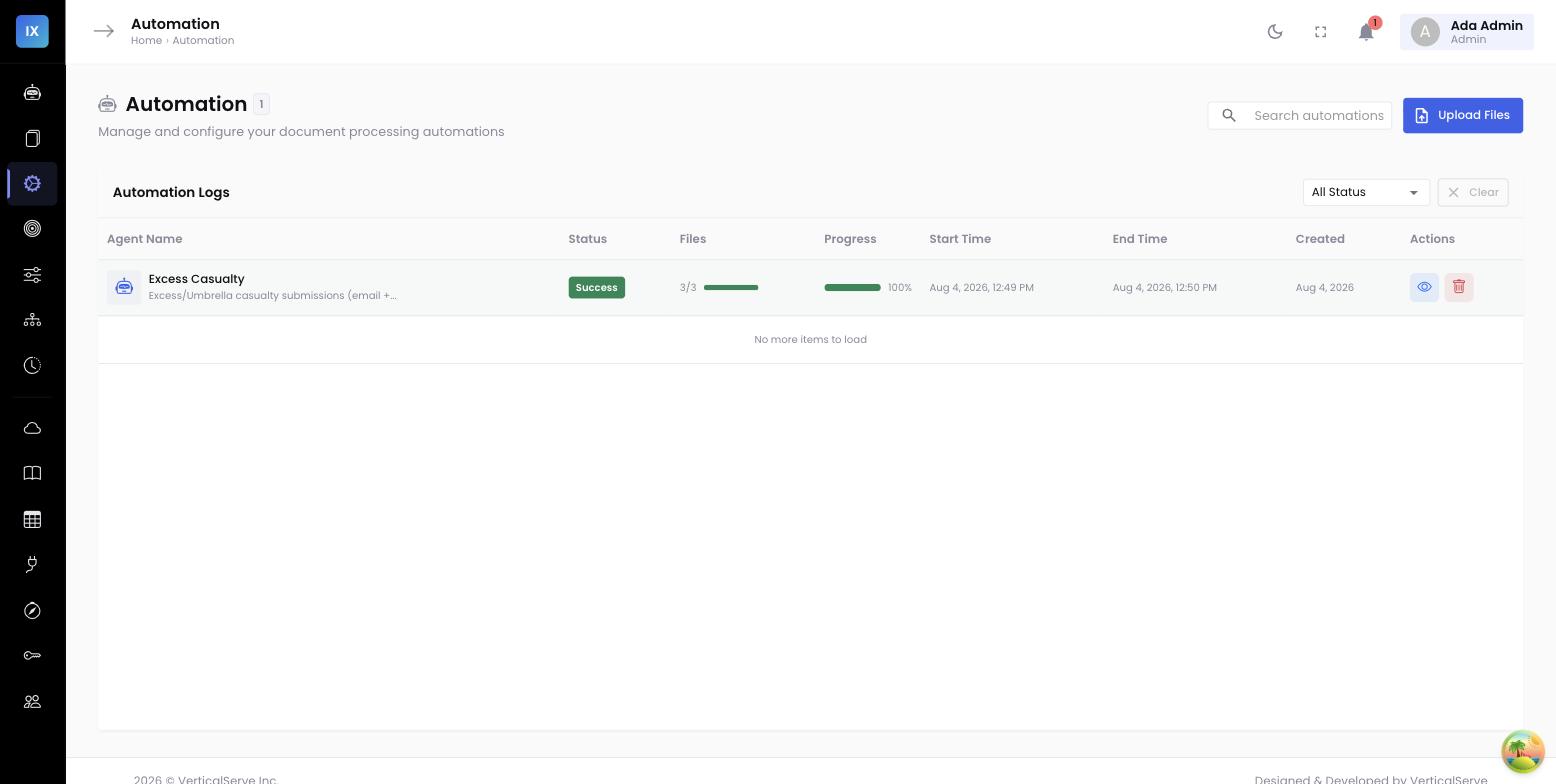
Consider a real-shaped submission. Summit Logistics, a regional trucking and warehousing operation, comes up for excess-casualty renewal. The broker sends one email with four attachments:
- A cover email summarizing the account, target premium, and effective date;
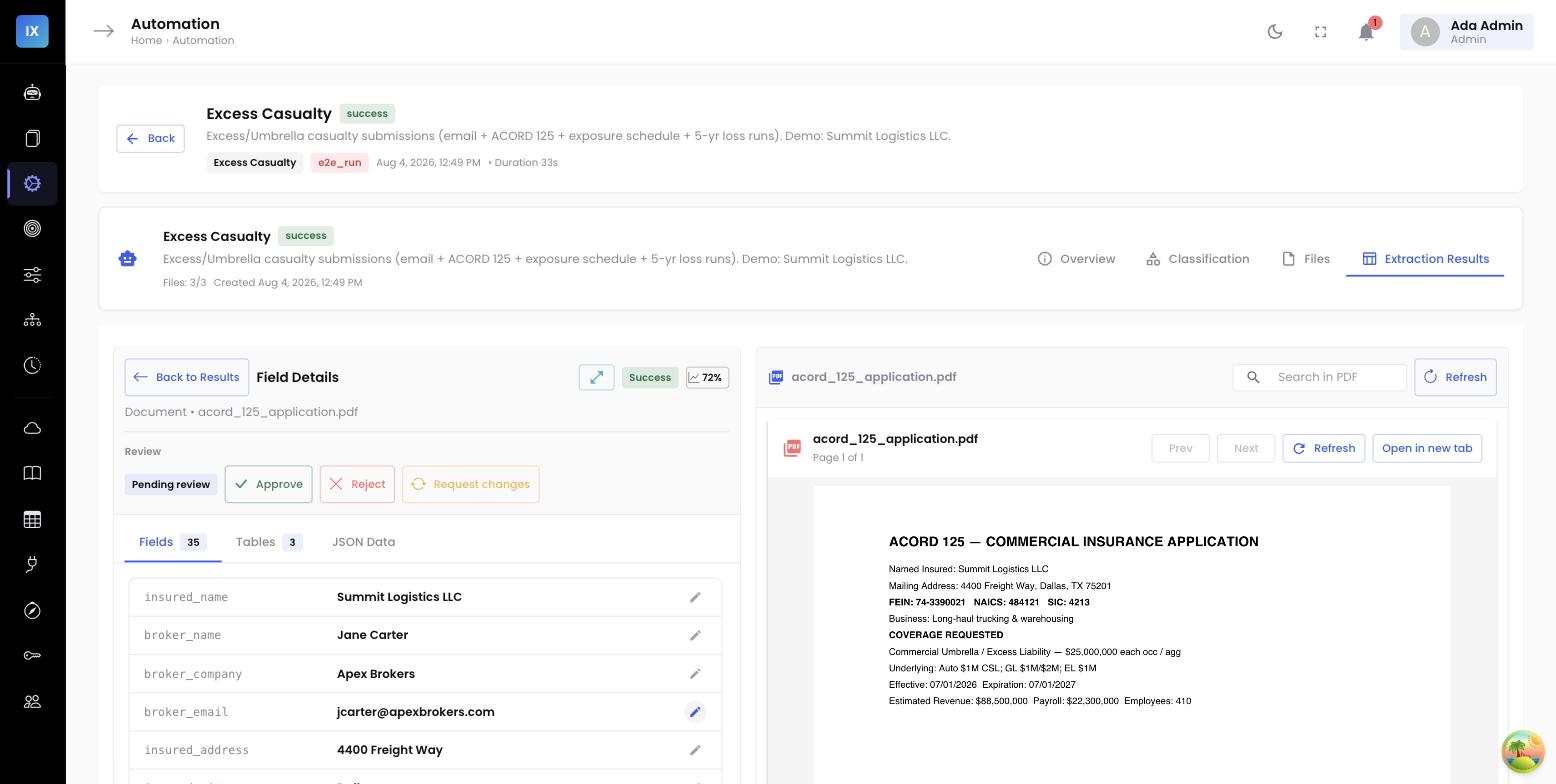
- An ACORD 125 (commercial insurance application) with the applicant and business details;
- An ACORD 131 (umbrella/excess) with the underlying-limits schedule;
- A statement of values listing locations and insured values;
- A five-year loss run with roughly 40 claim records.
In the manual world, an ops analyst opens the email, saves the attachments, works out which ACORD is which, and begins keying: named insured, FEIN, mailing address, SIC/NAICS, requested limits, underlying carriers and limits, then the SOV location schedule, then — the slow part — 40 loss records with dates, claimants, paid, reserved, and status. Realistically that is 35–45 minutes of careful work, and the loss run alone invites transcription error.
In the agentic pipeline, the email is ingested automatically. Every attachment is classified, each document is routed to its extraction spec, header fields and full tables are pulled with per-field confidence scores and bounding-box citations back to the source page, and the results are consolidated into a single submission record. The whole pass completes in a few minutes. Only fields below the confidence threshold — say a smudged loss-run figure on a scanned page — surface to a reviewer.
The numbers side by side
The table below is illustrative — your loaded rates and volumes will differ — but it shows the shape of the change on this one packet.
| Measure | Manual intake | Agentic STP | Change |
|---|---|---|---|
| Handling time | ~40 min keying + QA | ~3 min auto + ~4 min review* | ~80% less |
| Time in queue to quotable | 1–2 business days | Same morning | Hours, not days |
| Loaded handling cost | ~$32 / submission | ~$6 / submission | ~80% lower |
| Loss-run transcription errors | Manual, unbounded | Extracted + confidence-flagged | Flagged, not silent |
| Scaling with volume | Linear with headcount | Elastic (compute + exceptions) | Decoupled |
*Review time applies only to the fraction of submissions routed by confidence; straight-through cases incur no review time at all.
The STP funnel: what goes straight through, what gets routed
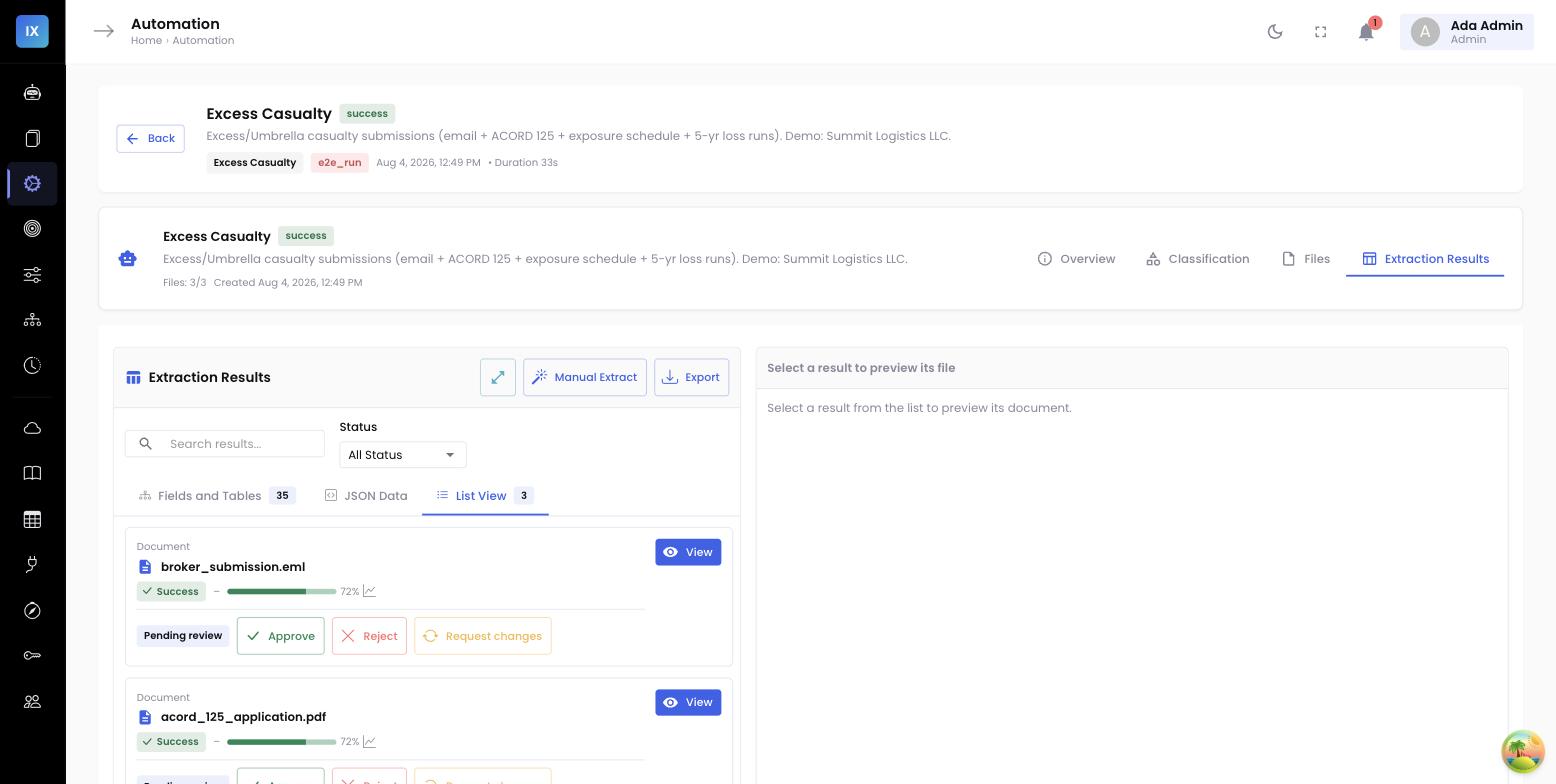
No serious operator claims 100% automation. The honest and durable model is a funnel: the large clean majority flows straight through, while a minority routes to a reviewer by confidence. The economics are driven by where that split lands and by the fact that even routed submissions are faster — the reviewer verifies and approves rather than transcribing from scratch.
flowchart TD
    S["100 submissions
ingested"] --> C["Classify + extract
every document"]
    C --> Q{"All fields above
confidence threshold?"}
    Q -- "Yes ~80" --> ST["Straight through
no human touch"]
    Q -- "No ~20" --> RV["Reviewer queue
verify flagged fields only"]
    RV --> AP["Approved record"]
    ST --> REC["Validated submission
records to PAS / clearance"]
    AP --> REC
The exact split depends on document quality, line of business, and how tightly you set thresholds. A clean, digitally-generated ACORD packet may go straight through in full; a stack of faxed, hand-annotated loss runs will route more often. The point is that the routed cases are contained and visible — you can see them, measure them, and drive them down over time by improving specs and glossaries.
What a COO should measure
If you are evaluating STP, hold the platform to operational metrics, not model-accuracy trivia. The numbers that map to P&L are:
- Straight-through rate — the share of submissions completed with no human touch. This is the single biggest driver of cost per submission.
- Time-to-record — median minutes from ingestion to validated record. This is your cycle-time lever.
- Review minutes per routed submission — how fast a reviewer clears an exception. Confidence scoring and citations keep this low.
- Cost per submission, blended — the all-in number that should fall and then flatten as volume grows.
The core shift
STP does not just make intake cheaper — it changes its cost curve. Manual intake scales linearly with volume because every submission needs a person. Agentic STP decouples volume from headcount: compute handles the many, skilled people handle the exceptions. That is what lets an underwriting operation grow without its intake cost growing with it.
None of this requires ripping out your systems. The validated record flows into the clearance or policy admin platform you already run; what changes is that a person no longer types it in. The Summit Logistics packet that used to consume most of an hour becomes a few minutes of compute and, at most, a few minutes of focused review — and the underwriter gets a clean, cited, quotable submission the same morning it arrived.
Related: where the human still belongs →
STP is not about removing people — it is about aiming them precisely. The companion post covers where AI should stop and a human should step in, and how confidence thresholds decide the split.