
An inland marine account looks simple next to an excess casualty tower — two documents instead of a dozen — but the pricing detail is just as unforgiving. A contractor’s equipment floater turns on the individual pieces of equipment and their values; a motor truck cargo or transit policy turns on what commodities move, how they move, and the values at risk per conveyance; and every account turns on its loss history. That detail doesn’t live in a header field — it lives in schedules, one row per item, often stapled to the back of an application or pasted into the body of an email.
Most intake tools read one document at a time and hand back a flat list of fields, flattening the schedules into nothing. That is not how an inland marine risk is underwritten. InsightXtract runs an agentic, multi-document pipeline that classifies each file, extracts to a per-document schema, consolidates the broker email and the application into one unified account record, links it into an entity graph, and validates it against your rules and reference data — so the underwriter opens a single, coded, cited record instead of an email thread and a PDF.
+ application
equipment · transit
loss history] --> B[Classify
each document] B --> C[Extract to the
right schema] C --> D[Consolidate
by source priority] D --> E[Link into an
entity graph] E --> F[Validate
rules + reference data] F --> G[One coded,
cited account record]
One submission, two documents, three schedules, one connected record — classify, extract, consolidate, link, validate.
The idea that governs everything: the schedules are the risk
Before the categories, the single most important concept. In inland marine, the header fields describe the account, but the schedules price it. A requested limit of $2M tells you the ask; the equipment schedule tells you whether that limit sits over ten items or two hundred, whether the values are ACV or replacement cost, and where the concentration is. A transit limit tells you the ceiling; the transit exposure table tells you what commodity is moving on what conveyance, and the annual values at risk. So InsightXtract captures these not as a single number but as tables — one row per item, conveyance, or claim. In the tables below, the Type column flags this explicitly:
- Point-in-time — a single static fact about the account.
- Current — a term-specific value for this submission.
- Per-row — a table: one equipment item, one conveyance/commodity, or one claim per row.
A · Insured & identity
Who the account is — legal identity, location, operations classification, and longevity. This is the account key everything else consolidates onto. Source: application form.
| Parameter | Type | Why it matters |
|---|---|---|
| Insured name · DBA name · FEIN | Point-in-time | The contract party and unique account key — drives clearance, conflicts, and de-dupe. |
| Insured address · city · state · ZIP | Point-in-time | Primary location and jurisdiction; state is standardized against the state-code lookup. |
| Business description · NAICS code | Point-in-time | Class-based rating and appetite/knockout; NAICS is validated against the reference table. |
| Entity type · years in business · website | Point-in-time | Legal structure, stability credit, and a quick operations sanity-check. |
B · Broker & submission
Who is placing the account and what kind of ask this is — pulled from the broker email, not the application. Source: submission email.
| Parameter | Type | Why it matters |
|---|---|---|
| Broker name · broker company | Point-in-time | Distribution routing, binding authority, and correspondence chain. |
| Broker email | Point-in-time | The reply-to and audit trail for every follow-up on the account. |
| Submission type | Current | New vs. renewal — sets the workflow and the rate-change baseline. |
C · Coverage form & valuation
The shape of the cover being requested — which inland marine form, how property is valued, and the catastrophe exposure it carries. These three decide how every scheduled value is interpreted. Source: application form.
| Parameter | Type | Why it matters |
|---|---|---|
| Coverage form | Current | Equipment floater, transit, builders’ risk, etc. — standardized against the coverage-form glossary so the form is coded consistently. |
| Valuation basis | Current | ACV vs. replacement cost vs. agreed value — changes what every scheduled value actually means at claim time. |
| Catastrophe exposure | Current | Flood, wind, quake exposure that drives cat load and aggregate management. |
D · Coverage, limits & retentions
The capacity being offered and the price attached to it — the core of the ask. Every monetary value here is normalized to currency and every date to ISO format on the way in. Source: application form.
| Parameter | Type | Why it matters |
|---|---|---|
| Requested limit | Current | The total capacity being asked for — the headline of the submission. |
| Each-occurrence limit · aggregate limit | Current | Per-loss ceiling and the term-wide cap on what the policy pays. |
| Deductible · retention | Current | Loss-sharing at the bottom of the tower — drives net exposure and price. |
| Premium | Current | The number to beat on a renewal and the rate-adequacy anchor. |
| Primary or excess | Current | Layer position — whether this cover attaches first or sits above other paper. |
| Effective date · expiration date | Current | The term and the binding deadline — normalized to YYYY-MM-DD. |
E · The equipment schedule — one row per item
The heart of a contractors’-equipment or scheduled-property floater. InsightXtract reads the equipment list as a table — one row per item — so the underwriter sees the composition of the schedule, not just its total. Source: application form.
| Parameter | Type | Why it matters |
|---|---|---|
| Item description | Per-row | What the item is — the basis for class, susceptibility to theft, and mobility. |
| Year · make / model | Per-row | Age and type — drives depreciation, valuation, and replacement availability. |
| Serial number | Per-row | Unique identity for the scheduled item — theft recovery and de-dupe across schedules. |
| Value | Per-row | Insured value per item — the rating base and the concentration signal; normalized to currency. |
F · Transit exposure — one row per commodity / conveyance
For cargo, motor truck cargo, and transit covers, this is where the real exposure lives. InsightXtract reads what moves, how it moves, and the values at risk — one row per commodity/conveyance combination. Source: application form.
| Parameter | Type | Why it matters |
|---|---|---|
| Commodity | Per-row | What is being shipped — perishability, theft attractiveness, and hazard grade. |
| Conveyance | Per-row | How it moves (truck, rail, vessel) — the mode that drives loss frequency and severity. |
| Annual values | Per-row | Total values in transit over the year — the primary transit exposure base; normalized to currency. |
| Limit per conveyance | Per-row | Maximum value at risk in a single shipment — the catastrophe cap for a single loss. |
G · Loss history — one row per claim
The single biggest pricing input on any renewal. InsightXtract reads each claim as a row, capturing not just the paid amount but the open reserve and total incurred — so the underwriter sees development, not just closed cost. Source: application form.
| Parameter | Type | Why it matters |
|---|---|---|
| Claim number · date of loss | Per-row | The loss’s identity and when it happened — date normalized to YYYY-MM-DD for trend analysis. |
| Description | Per-row | Cause and nature of loss — theft, collision, water — the escalation-potential signal. |
| Status | Per-row | Open vs. closed — open claims still carry development risk on the books. |
| Paid · reserve · incurred | Per-row | What’s been paid, what’s held open, and the total — the frequency-and-severity picture; all normalized to currency. |
From two documents to one connected record
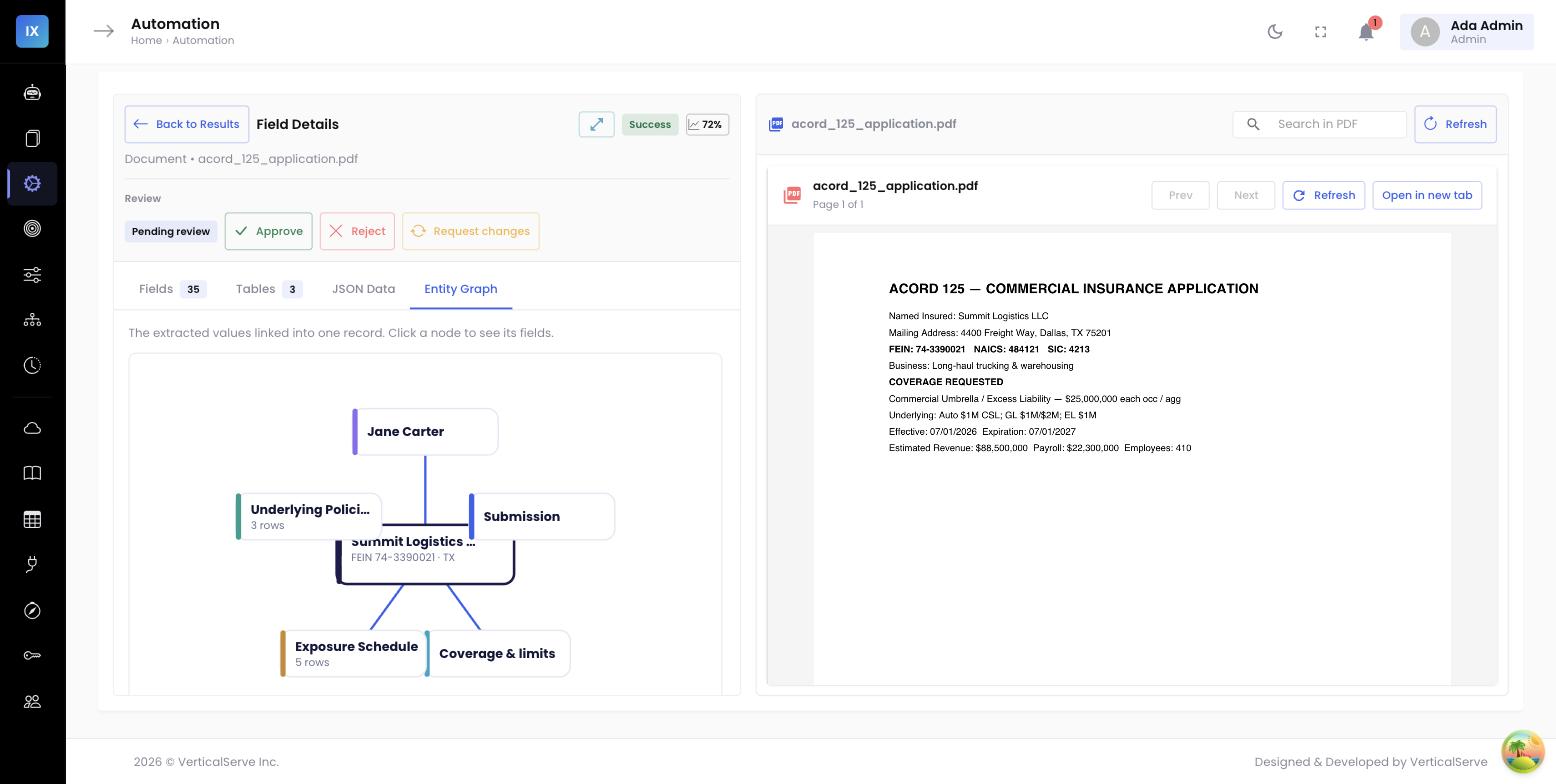
Pulling these parameters out of the email and the application is only half the job. The value is in consolidation: the insured named on the application, the broker on the email, the equipment and transit and loss schedules — they all describe one account. InsightXtract merges them into a single record by a declared source-of-truth priority (the application wins on insured and coverage detail; the email is the source for broker and submission-type fields), and links the result into an entity graph — the insured at the centre, connected to the broker, the submission, the coverage terms, the equipment schedule, the transit exposure, and the loss history.
Why the graph, not just a form
An underwriter doesn’t think in flat fields — they think in relationships: does the requested limit line up with the total scheduled equipment value? Does the transit limit-per-conveyance actually cover the largest commodity moving on the account? Does the loss history match the exposure? The entity graph makes those connections explicit and clickable, with every value cited back to the page it came from.
Reference data and validation, built in
Extraction is only trustworthy if the values are clean and checked. On the way into the record, InsightXtract standardizes the insured state against the US state-code lookup, the NAICS code against the NAICS reference table, and the coverage form against the inland marine coverage-form glossary — so the same form is always coded the same way. Every monetary field (limits, deductible, retention, premium, equipment values, transit values, and each claim’s paid/reserve/incurred) is normalized to currency, and every date to ISO format. Then it validates: the insured name is required, and the state and NAICS code are checked against their lookups — flagged as warnings if they don’t match — before the record ever reaches the underwriter.
Why it matters to the business
Comprehensive, structured, schedule-aware extraction isn’t a data-entry nicety — it changes the economics and quality of the book:
- Better-priced risk. Capturing the equipment schedule and transit exposure row by row — not as a single total — lets you rate to the composition and concentration, which is where inland marine money is won or lost.
- Fewer missed exposures. The details that cause surprises — an ACV-vs-replacement mismatch, a high-value single conveyance, a developing open claim — are exactly the ones buried in the schedules. Extracting them by default means they reach the underwriter, not the claim file.
- Faster quotes, more capacity. An underwriter opening a consolidated, cited record instead of an email thread and a PDF triages and prices in minutes, not hours — more submissions handled without more headcount.
- Consistency and auditability. The same fields, coded and validated the same way, every time — with provenance to the source document. That is the difference between a repeatable book and one that depends on which underwriter opened the file.
- Portfolio intelligence. Once every submission is coded to the same schema, equipment values, transit exposures, and loss development roll up — you can see concentration and loss trends across the whole book, not one account at a time.
The Inland Marine agent extracts all of this today — the insured and identity; the broker and submission; the coverage form, valuation, and catastrophe exposure; the limits, retentions, and premium; and the three schedules that carry the risk — consolidated into one coded record of 27 header fields and three linked tables, every monetary value normalized, every code validated against reference data, and every value cited to its source document. The point this post makes is why it matters: the schedules are what move an inland marine price, so they’re captured by default. And because it’s all configuration — fields and tables in the agent’s output contract, not code — the schema keeps pace with what underwriters ask for.
Related reading →
See the same pipeline applied to other lines: inside an excess casualty submission, and what InsightXtract extracts from a commercial property submission.