
An Equipment Breakdown submission looks simple next to a casualty packet — usually a broker email and a single application form — but the underwriting is anything but. The object schedule is a piece of engineering: boilers, chillers, transformers, compressors, production lines and refrigeration systems, each with a value and a location. And the exposure that actually costs money isn’t only the object itself — it’s the business interruption when that object goes down. The data that decides the price is spread across the application’s equipment table, the requested limits, and whatever loss history is attached. It is almost never on any one line.
Most intake tools read the application top-to-bottom and hand back a flat list of fields, flattening the object schedule and the loss run into unusable text. That is not how an Equipment Breakdown account is underwritten. InsightXtract runs an agentic, multi-document pipeline that classifies each file, extracts to a per-document schema, consolidates everything into one unified account record by declared source priority, and validates it against your rules and reference data — so the underwriter opens a single, coded, cited record instead of a PDF and an email thread.
+ application
object schedule
loss history] --> B[Classify
each document] B --> C[Extract to the
right schema] C --> D[Consolidate
by source priority] D --> E[Standardize
codes + currency] E --> F[Validate
rules + reference data] F --> G[One coded,
cited account record]
One submission, two documents, one connected record — classify, extract, consolidate, standardize, validate.
The idea that governs everything: the schedule and the interruption are the risk
Before the fields, the concept that shapes the whole extraction. In Equipment Breakdown, the object schedule is the exposure and the interruption is the loss. A single stated total insured value tells you very little; a schedule showing a $2.4M turbine, a $900K chiller plant, and a line of production presses at one location tells you where the failure will hurt and how much of it sits under one roof. That is why InsightXtract does not flatten the schedule — it captures it as a table, one object per row, so the concentration, the object mix, and the single largest exposed value are all visible.
In the tables below, the Captured column flags how each parameter is pulled:
- Current — captured once for this submission/term.
- Point-in-time — a single static fact about the account.
- Per-row — a table: one equipment object, or one claim, per row.
A · Insured identity & operations
Who the account is, how it’s structured, and what it does — the classification that drives appetite and the object types you’d expect to see. Source: application form.
| Parameter | Captured | Why it matters |
|---|---|---|
| Insured name · DBA name · FEIN | Point-in-time | The contract party and unique account key — drives clearance, conflicts, and de-dupe. |
| Insured address · city · state · ZIP | Point-in-time | Primary premises and the venue for the risk; insured_state is standardized to the US state-code table. |
| Business description · NAICS code | Point-in-time | Class-based appetite and the object profile to expect — NAICS is standardized against the reference table. |
| Entity type · years in business · website | Point-in-time | Legal structure, stability credit, and a quick corroboration channel. |
B · Broker & submission
Who is placing the account and what kind of transaction it is — the distribution and workflow context. Source: broker email.
| Parameter | Captured | Why it matters |
|---|---|---|
| Broker name · broker company | Point-in-time | Distribution routing, binding authority, and the relationship behind the ask. |
| Broker email | Point-in-time | The correspondence channel and a clearance signal against duplicate submissions. |
| Submission type | Current | New vs. renewal vs. quote — sets the workflow and the rate-change baseline. |
C · Coverage, limits & retentions
The exact shape of the Equipment Breakdown cover being requested — the total value at stake, the per-breakdown ceiling, and what the insured keeps. Every dollar field here is standardized to whole-dollar currency, and the dates to ISO format. Source: application form.
| Parameter | Captured | Why it matters |
|---|---|---|
| Total insured value | Current | The aggregate value of equipment exposed to breakdown — the headline exposure the cover sits over. |
| Each-breakdown limit | Current | The most the policy pays for a single breakdown event — the core capacity of the ask. |
| Requested limit · each-occurrence limit · aggregate limit | Current | The full limit structure being offered — per-event and annual ceilings on the carrier’s exposure. |
| Deductible · retention | Current | What the insured absorbs before the policy responds — drives attachment and net price. |
| Premium · primary or excess | Current | The price and the layer position — standalone primary vs. sitting excess of another tower. |
| Effective date · expiration date | Current | Term boundaries and the binding deadline — normalized to YYYY-MM-DD. |
D · The equipment object schedule — one row per object
The engineering heart of the submission. InsightXtract reads the equipment schedule as a table — one row per object — instead of flattening it into text, so object mix, value concentration, and location clustering all survive. Source: application form · table equipment_objects.
| Column | Captured | Why it matters |
|---|---|---|
| Object type | Per-row | Boiler, chiller, transformer, compressor, turbine, production line — the object class drives failure mode and severity. |
| Description | Per-row | Make, capacity, and function — the detail that separates a routine unit from a critical, hard-to-replace one. |
| Value | Per-row | The insured value of the object — standardized to whole dollars; the per-row values are what surface the single largest exposure. |
| Location | Per-row | Where the object sits — reveals whether high-value equipment is concentrated at one site or spread across many. |
E · Loss history — one row per claim
The single biggest pricing input after the schedule. InsightXtract reads each claim as a row and preserves the paid / reserve / incurred split so open development is visible, not buried. Source: application form · table loss_history.
| Column | Captured | Why it matters |
|---|---|---|
| Claim number · date of loss | Per-row | Each loss’s identity and timing — the basis for frequency over the experience period; date normalized to YYYY-MM-DD. |
| Description | Per-row | What broke and how — distinguishes a one-off electrical arc from a recurring mechanical failure pattern. |
| Status | Per-row | Open vs. closed — open claims carry development risk still on the books. |
| Paid · reserve · incurred | Per-row | Cost to date, the carrier’s estimate of what remains, and total incurred — the shape of the loss and its severity trend; all in standardized currency. |
From two documents to one connected record
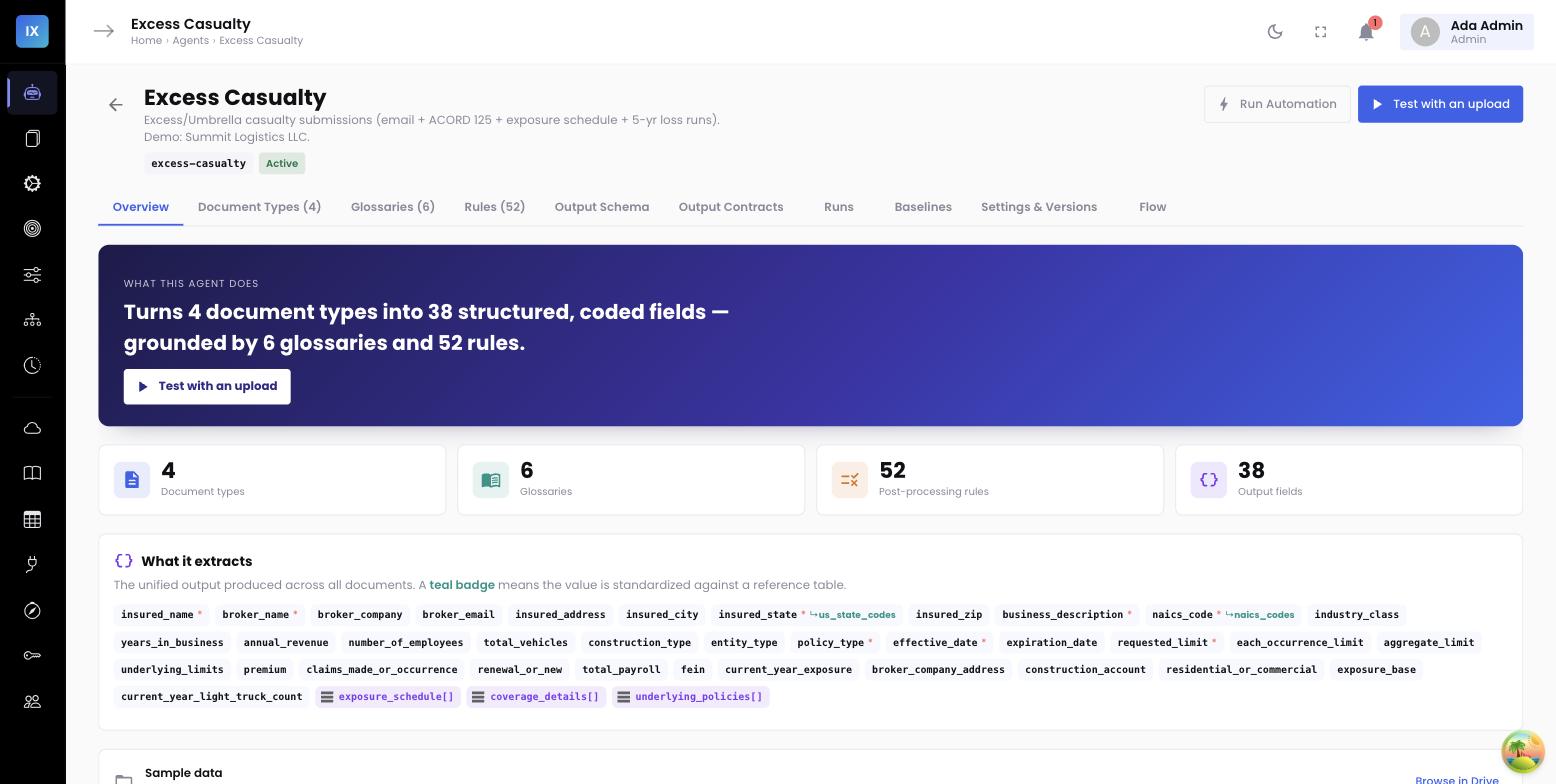
Pulling these parameters out of an email and an application is only half the job. The value is in consolidation: the insured on the application, the broker on the email, the limits on the form, the objects on the schedule, and the claims on the loss run all describe one account. InsightXtract merges them into a single record by a declared source-of-truth priority — the application form is authoritative for the insured, coverage, and both tables; the broker email is authoritative for the broker and submission type — and every value is cited back to the document and field it came from.
Standardized, not just extracted
Extraction alone isn’t enough for a repeatable book. InsightXtract post-processes every record: the state is standardized against the US state-code table, the NAICS code against the reference table, every dollar field to whole-dollar currency, and every date to YYYY-MM-DD. Then it validates — insured name is required, and out-of-table state or NAICS values raise a warning — so the record that reaches the underwriter is clean, coded, and checked.
Why it matters to the business
Comprehensive, structured extraction of the object schedule and loss history isn’t a data-entry nicety — it changes the economics and quality of an Equipment Breakdown book:
- The object schedule is the exposure. Capturing every object as a row — type, description, value, location — means the underwriter sees the object mix and the single largest exposed value, not just a total. Concentration risk at one location is visible instead of hidden.
- Business interruption is priced, not guessed. The equipment that fails is rarely the whole loss — the interruption to production is. Knowing which critical objects sit where lets the underwriter reason about downtime severity, the exposure that actually drives Equipment Breakdown claims.
- Loss development reaches the desk. Preserving the paid / reserve / incurred split per claim means an open, developing loss shows up as open exposure — not as a single flattened number that looks settled.
- Faster quotes, clean data. An underwriter opening a consolidated, standardized, cited record instead of an application PDF and an email thread triages and prices in minutes — more submissions handled without more headcount.
- Consistency and auditability. The same fields, coded and standardized the same way every time, with provenance to the source document — the difference between a repeatable book and one that depends on which underwriter opened the file.
The Equipment Breakdown agent extracts all of this today — the insured identity and operations, the broker and submission context, the full coverage-and-limits structure, the equipment object schedule broken out one object per row, and the loss history with per-claim paid, reserve, and incurred — consolidated into one coded record with two linked tables, every value standardized and cited to its source. And because it’s all configuration — fields and tables in the agent’s output contract, not code — the schema keeps pace with what your underwriters ask for.
Related reading →
See how the same pipeline handles other P&C lines: inside an excess casualty submission, and inside a commercial property submission.