
Builders risk is a course-of-construction cover, and that makes it unusual. You are not insuring a stable, existing business — you are insuring a project that starts at ground level, rises in value every month, and disappears the day it is complete. The exposure is the building being built, valued at completion; the term is the construction schedule; and the hazard is everything that can go wrong on an active job site before the structure is finished and handed over. Get the project value, the split between hard and soft costs, the construction type, and the term right, and you have priced the risk. Miss one and you have mispriced it.
The submission that carries all of this is short — typically a broker’s email with the ask and a builders risk application form — but the data is dense and connected. InsightXtract runs an agentic, multi-document pipeline that classifies each file, extracts to a per-document schema, consolidates the two sources into one unified account record by source priority, and validates it against your reference data — so the underwriter opens a single, coded, cited record instead of a form and an email thread.
+ Builders Risk
application form] --> B[Classify
each document] B --> C[Extract to the
right schema] C --> D[Consolidate
by source priority] D --> E[Link into an
entity graph] E --> F[Validate
rules + reference data] F --> G[One coded,
cited account record]
One submission, two documents, one connected record — classify, extract, consolidate, link, validate.
The idea that governs everything: value at completion is the exposure
Before the fields, the single most important concept. In builders risk, the exposure is the total value of the project at completion — not what stands on the site today. A tower that is a hole in the ground on the effective date will be a $60M structure by the completion date, and the policy has to cover the peak value it will reach. That is why the total project value, and the way it splits into hard costs (materials and labor that become the building) and soft costs (design, permits, financing, lost income), sits at the centre of every builders risk quote. Two projects with the same total value but very different soft-cost loads are very different risks.
The rest of the record exists to qualify that exposure: who the insured is, what the project is and how it’s built, how long it will be under construction, and what the coverage terms are. In the tables below, the Captured column flags how each field is held:
- Current — a value captured once for this project / term.
- Point-in-time — a static identity or classification fact.
- Per-row — a table: one building / project per row in the project schedule.
A · Insured and identity
Who the account is — the contract party, its legal structure, and how it’s classified for rating and appetite. Sources: application form, broker email.
| Parameter | Captured | Why it matters |
|---|---|---|
| Named insured · DBA · FEIN | Point-in-time | The contract party and unique account key — drives clearance, conflicts, and de-dupe. |
| Address · risk state | Point-in-time | Mailing/physical location and the primary rating jurisdiction — standardized against the state-code reference table. |
| NAICS code · SIC code · entity type | Point-in-time | Class-based rating, appetite/knockout, and legal form — NAICS validated against reference data. |
| Business description · years in business | Point-in-time | Nature of operations and contractor track record — the stability signal behind the code. |
B · Firmographics & exposure base
The size of the operation behind the project — the financial and workforce base that qualifies the insured. Source: application form.
| Parameter | Captured | Why it matters |
|---|---|---|
| Estimated revenue | Current | Annual sales — the scale of the contracting operation, formatted as currency. |
| Total payroll | Current | Workforce exposure base and a proxy for the volume of work in progress. |
| Employee count | Current | Workforce size — operational scale relative to the project taken on. |
C · Project profile — the exposure itself
This is the heart of the builders risk record. Where the project is, what it is, how it’s built, and — above all — what it’s worth and how that value is composed. Source: application form.
| Parameter | Captured | Why it matters |
|---|---|---|
| Project name · project address | Current | Identifies the specific job site — the physical location of the exposure and its catastrophe geography. |
| Project type | Current | New build vs. renovation vs. addition — renovations over an existing structure carry very different hazards. |
| Total project value | Current | The value at completion — the core exposure the policy limit must reach, formatted as currency. |
| Hard costs | Current | Materials and labor that become the building — the physical-damage exposure that rises as the job progresses. |
| Soft costs | Current | Design, permits, financing, and lost income — consequential exposure a delay or loss triggers, priced separately. |
| Construction type | Point-in-time | Frame vs. masonry vs. fire-resistive — the single biggest driver of fire and wind vulnerability. |
| Number of stories | Point-in-time | Height and complexity — a signal of construction difficulty, wind exposure, and value concentration. |
D · Term & construction schedule
Builders risk is a term-of-construction cover, so the schedule is part of the exposure. A longer job means more months of exposure and more chance the value peaks before it’s handed over. Sources: application form, broker email.
| Parameter | Captured | Why it matters |
|---|---|---|
| Project start date · project completion date | Current | The construction window — when exposure begins and when it should end, normalized to ISO dates. |
| Coverage term (months) | Current | The policy period being rated — and whether it actually spans the full build with margin. |
| Project duration (months) | Current | Expected build length — longer schedules raise cumulative exposure and overrun risk. |
| Effective date | Current | Inception of cover and binding deadline — normalized to an ISO date. |
E · Coverage, limits & program structure
The ask itself and the terms that shape it — the product, the requested limit, the retention, and any wrap-up program governing the site. Sources: broker email, application form.
| Parameter | Captured | Why it matters |
|---|---|---|
| Product · requested limit | Current | The coverage form and capacity being requested — the core of the ask. |
| Deductible | Current | Retained loss — the insured’s share of each event and a direct rate lever, formatted as currency. |
| Existing structure value | Current | Value of any structure already standing on a renovation/addition — exposure beyond the new work. |
| Wrap-up type | Point-in-time | OCIP/CCIP or none — who carries the program and how liability is consolidated across the site. |
| Premium | Current | The quoted or target premium — the price-to-beat and rate baseline, formatted as currency. |
F · Broker & submission
Who’s placing the account and how to route it — the distribution chain and correspondence path. Source: broker email.
| Parameter | Captured | Why it matters |
|---|---|---|
| Broker name · broker email | Point-in-time | Distribution routing, binding authority, and the correspondence address for the quote. |
G · The project schedule — one row per project
Many builders risk policies cover more than one building or phase under a single account. InsightXtract reads the schedule as a table — one row per project — so each building’s value and timeline is captured individually rather than collapsed into a total. Source: application form.
| Column | Captured | Why it matters |
|---|---|---|
| Project name | Per-row | Identifies each building or phase under the policy for scheduling and reporting. |
| Address | Per-row | The specific site of each scheduled project — per-location catastrophe and aggregation exposure. |
| Value | Per-row | Completion value of each project — the per-building exposure, formatted as currency, that rolls up to the total. |
| Start date · completion date | Per-row | Each project’s construction window — overlapping schedules concentrate exposure in time, normalized to ISO dates. |
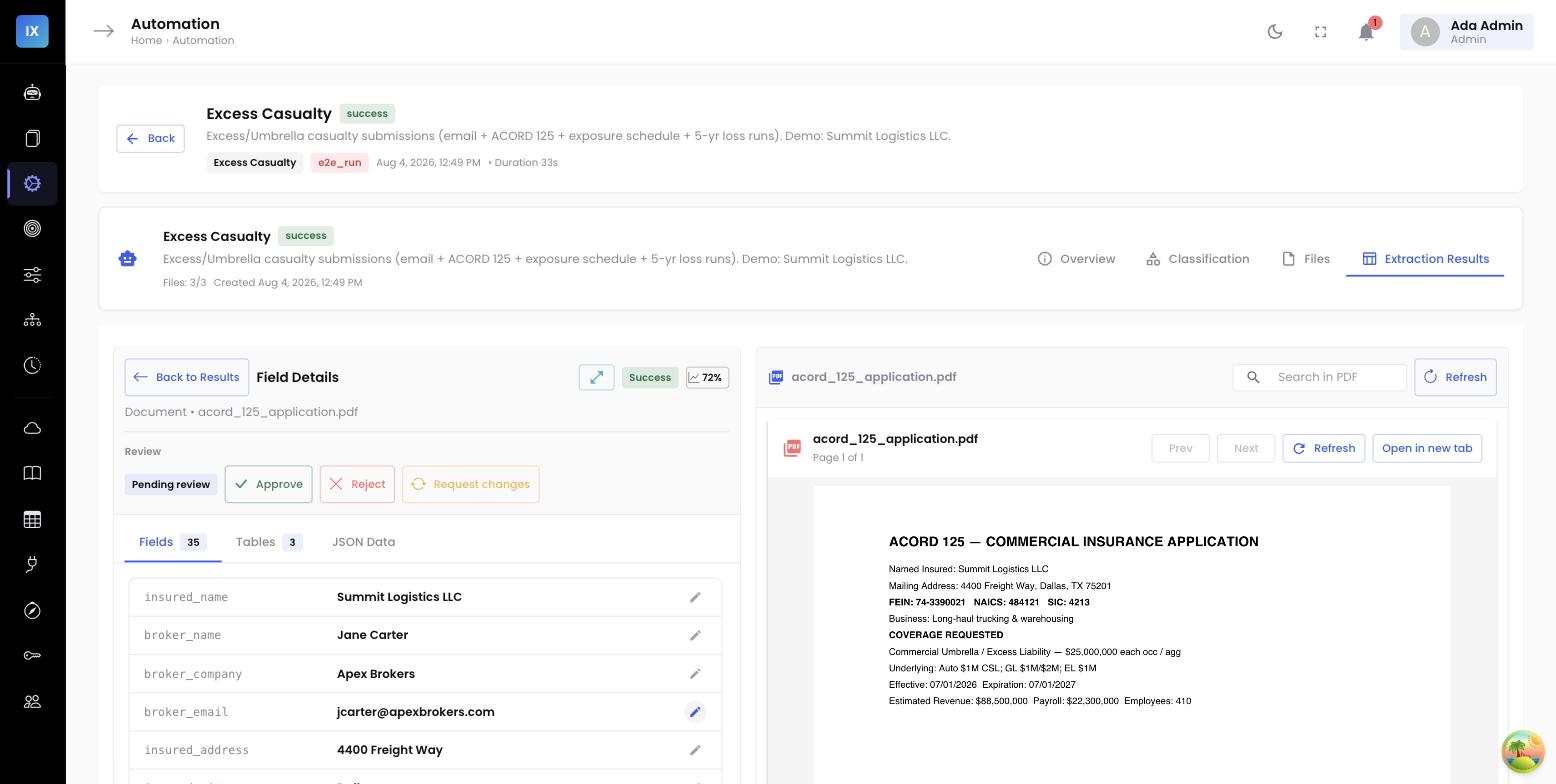
From two documents to one connected record
Pulling these fields out of a form and an email is only half the job. The value is in consolidation: the insured named on the application, the broker on the email, the project value and construction detail on the form, and the requested limit in the ask all describe one account. InsightXtract merges them into a single record by a declared source-of-truth priority — the application form wins on project details like address, type, dates, construction, and deductible, while the broker email carries the broker identity, product, effective date, and requested limit — and links the result into an entity graph with the insured at the centre, connected to broker, project, coverage, and the project schedule.
Coded and validated, not just captured
Extraction is only trustworthy if it’s consistent. InsightXtract standardizes the risk state and NAICS code against reference tables, formats every dollar amount as clean currency and every date to ISO, and validates the record with rules — the insured name is required, and the state and NAICS codes raise a warning if they don’t match the reference data. Provenance and confidence are attached to every value.
Why it matters to the business
Comprehensive, structured, validated extraction of a builders risk submission isn’t a data-entry nicety — it changes the economics and quality of the book:
- Project value and soft costs = the exposure. Capturing total project value alongside the hard/soft-cost split, by default, means the layer is rated on the value it will actually reach at completion — and the consequential soft-cost load is priced, not missed.
- Term is risk. The construction window and coverage term drive how long the exposure is live. Extracting start, completion, and term months makes overrun and gap risk visible before binding, not after a claim.
- Construction type moves the price. Frame vs. masonry vs. fire-resistive, plus stories and existing-structure value, are exactly the vulnerability signals that decide the rate — captured every time, coded the same way.
- Faster quotes, fewer surprises. An underwriter opening a consolidated, cited record instead of a form plus an email thread triages and prices in minutes — and the per-project schedule surfaces multi-building aggregation instead of hiding it in a total.
- Consistency and auditability. The same fields, standardized and validated the same way, with provenance to the source document — the difference between a repeatable book and one that depends on which underwriter opened the file.
The Builders Risk agent extracts all of this today — insured identity and firmographics; the full project profile with value, hard/soft-cost split, construction type, and stories; the construction term; coverage, deductible, existing-structure value, wrap-up, and premium; the broker and submission; and the per-project schedule — consolidated into one coded record with every value standardized, validated, and cited to its source document. And because it’s all configuration — fields and tables in the agent’s output contract, not code — the schema keeps pace with what your underwriters ask for.
Related reading →
See how the same pipeline handles other lines: inside an excess casualty submission, and what InsightXtract extracts from a commercial property submission.