
Here is the uncomfortable truth about most “human-in-the-loop” extraction: the human is in the loop, but the loop never closes. A reviewer catches the same error on Monday, catches it again on Tuesday, and catches it a hundred more times over the quarter — each time fixing the value on that one document and moving on. The corrections pile up as isolated edits. The agent, meanwhile, learns nothing, because nothing ever travels back to it. That is not a loop; it is a treadmill.
A closed loop is different. When a reviewer corrects a value, that correction — together with the reason it was wrong — becomes an input the platform can learn from. Enough of the same correction, seen enough times, becomes evidence that the agent has a systematic blind spot. Someone acts on that evidence, updates the agent, and the error stops appearing. The reviewer’s effort compounds instead of repeating. That is what InsightXtract is built to do.
The loop, drawn
The mechanism is a cycle with five stops. A reviewer’s edit is not the end of the story; it is the first step of the next improvement.
flowchart LR
    R["Reviewer edits a field
or classification
+ records a reason"]
    S["Correction store
old → new, reason,
who, when, citation"]
    T["Tuning analysis
clusters recurring
corrections by pattern"]
    U["Agent update
prompt / rule / glossary
reviewed & published"]
    F["Fewer corrections
next time
(error prevented at source)"]
    R --> S --> T --> U --> F
    F -. "residual edits feed back" .-> R
The dotted line matters as much as the solid ones. Even after an agent update, a few edge cases will still need a human — and those feed the next turn of the cycle. The goal is not zero review; it is a review burden that shrinks over time as the agent absorbs what reviewers already know.
Step one: review with enough context to be fast
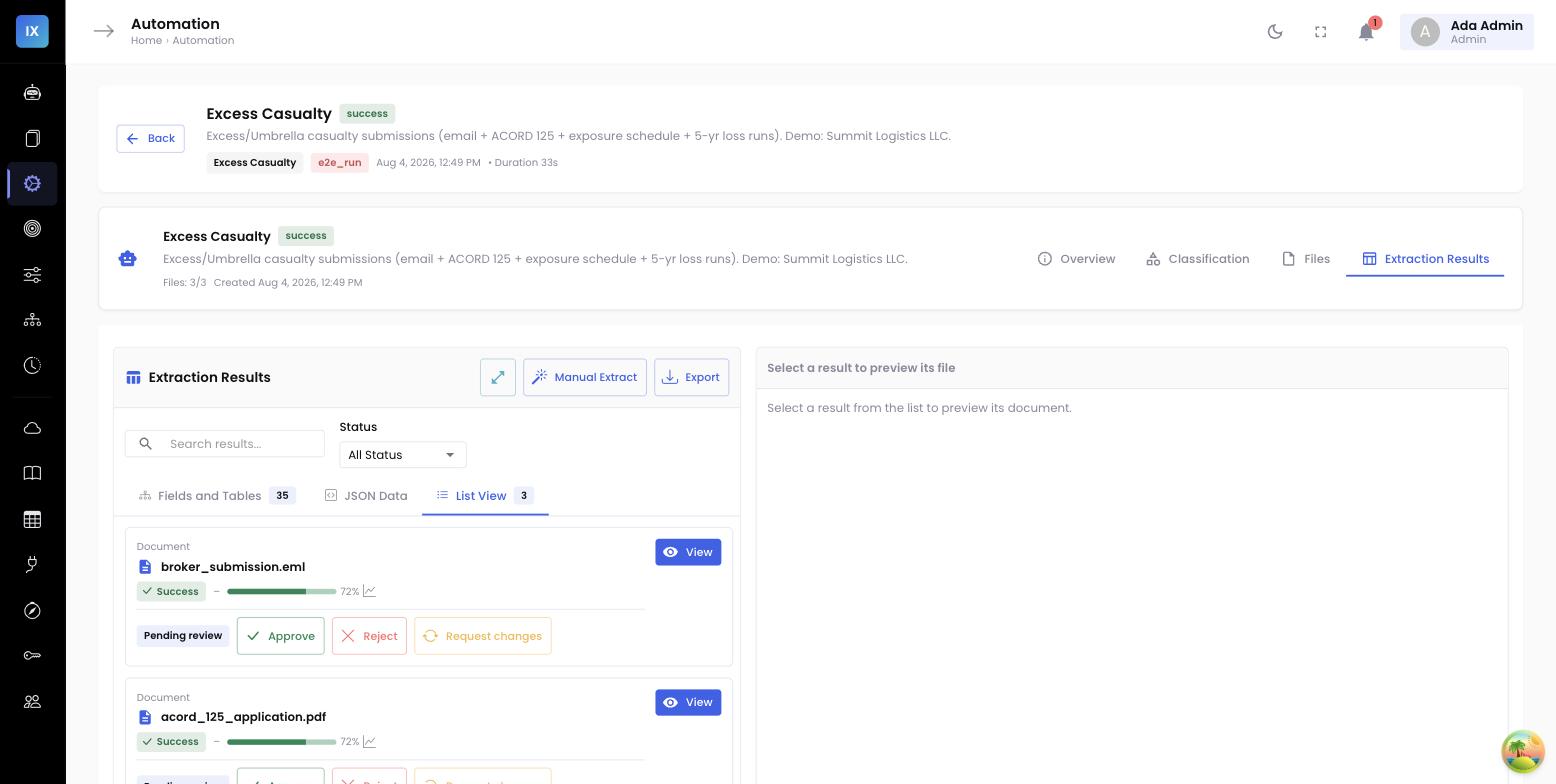
A closed loop starts with review that is quick and confident, because a reviewer who has to re-read the whole document to check one field will not last a quarter. The InsightXtract review queue puts each item in context: the extracted value, its confidence score, and a one-click jump to the exact spot on the source page it came from. Low-confidence and conflicting fields surface first, so scarce reviewer attention lands where it changes the outcome.
Step two: capture the correction and the reason
This is the step almost everyone skips, and it is the one that makes learning possible. When a reviewer changes a value, InsightXtract records not just old and new, but why — a structured reason attached to the correction. “Wrong number” teaches the agent nothing. “Column header says Incurred but the agent mapped it to Paid” teaches it exactly where it went wrong. The reason is what turns a one-off fix into a reusable signal.
Step three: the correction store turns edits into patterns
Individually, corrections are anecdotes. Aggregated, they are data. Every correction flows into a correction store, keyed by document class and field, where the platform can see what individual reviewers cannot: that the same paid-vs-incurred swap has now been fixed forty-seven times, always on loss runs from the same carrier layout, always on the same two adjacent columns. That is no longer an anecdote. That is a defect with a signature.
This aggregation is what makes prioritization honest. Instead of guessing where the agent is weakest, underwriting ops can look at the correction store and see the top recurring corrections ranked by frequency and cost — the ones burning the most reviewer hours and posing the most downstream risk. A paid/incurred mislabel is not cosmetic; incurred losses drive loss ratios, pricing, and reserving, so a systematic swap corrupts analytics far past the one document where it was caught.
Step four: tuning consumes the corrections
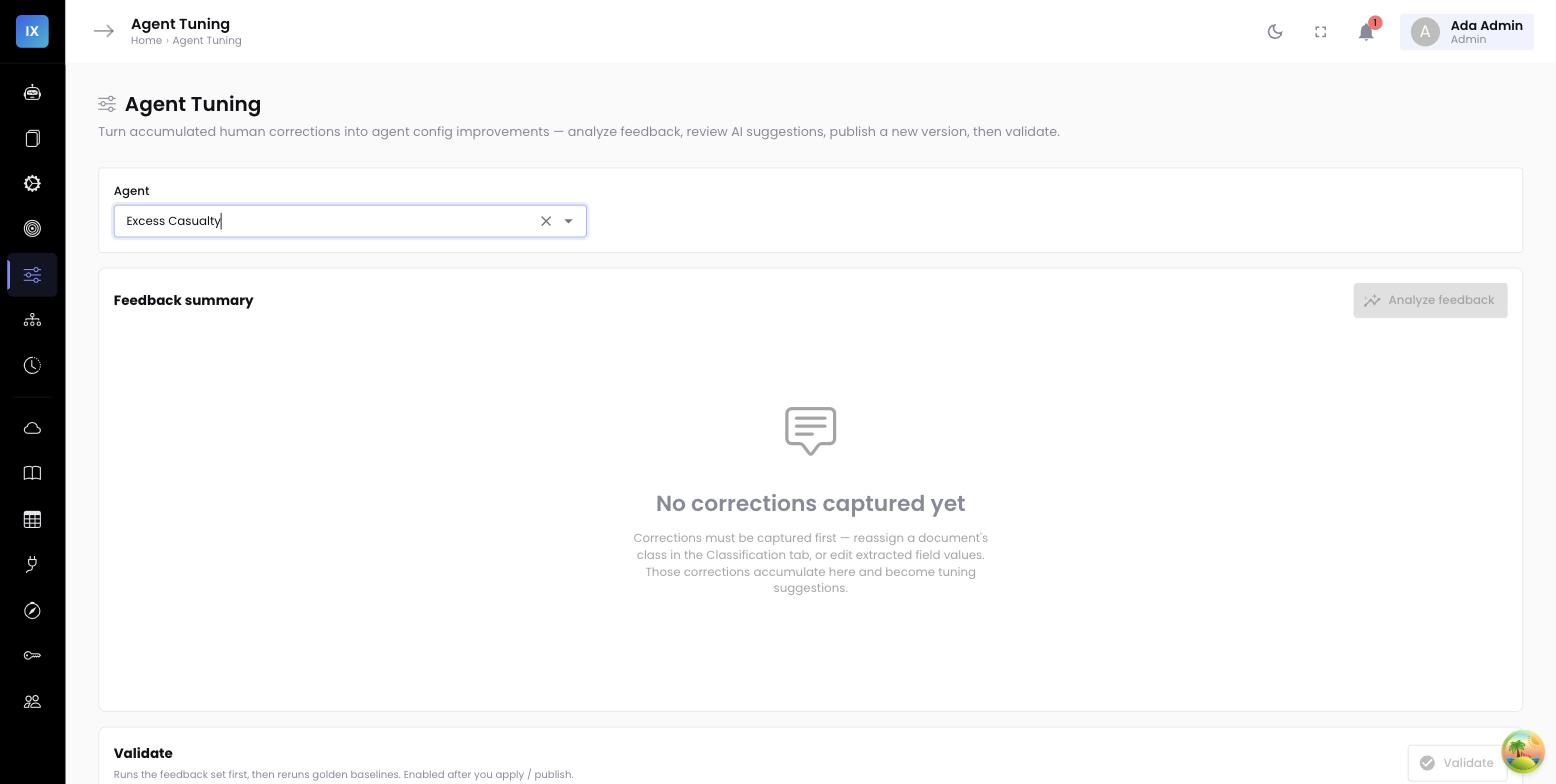
The Agent Tuning page is where the accumulated corrections become a change. It surfaces the clustered patterns from the correction store and proposes the smallest fix that addresses each — often a sharper prompt instruction, a post-processing rule, or a glossary entry that pins the column mapping for that carrier’s layout. A Builder reviews the proposal against the evidence, adjusts it, and an Admin publishes it as a new agent version. Crucially, the humans stay in charge: the corrections inform the update; they do not silently mutate the agent on their own.
Step five: fewer corrections next time
Once the tuned agent version is live, the next batch of that carrier’s loss runs is read with the columns mapped correctly. The reviewer who fixed the paid/incurred swap forty-seven times sees it zero times on the forty-eighth batch. The correction store confirms it: the cluster that used to sit at the top of the ranking flattens toward zero. That is the loop closing — a human taught the agent something once, and the agent now applies it everywhere, forever, without being asked again.
And because everything is versioned and attributable, the improvement is auditable too. You can point to the corrections that motivated the change, the version that shipped it, and the drop in recurrence that followed. The quality story is not a claim; it is a measured curve.
Review that compounds vs. review that repeats
The difference between the two is a single design choice: does a correction end at the record, or does it travel back to the agent with its reason intact? When it travels, reviewer effort compounds — every fix makes the next batch cleaner. When it ends at the record, reviewers run the same treadmill forever. Closing the loop is what turns human review from a cost center into a source of durable quality.
Why this matters to the business
- Falling review burden. Recurring errors get fixed at the source, so the volume of manual corrections trends down instead of scaling linearly with document volume.
- Better data where it counts. A paid/incurred swap caught and prevented protects loss ratios, pricing, and reserving — not just the one document a reviewer happened to open.
- Reviewer expertise, retained. The reason behind each correction captures institutional knowledge that would otherwise walk out the door; the agent keeps it.
- Improvement you can prove. Corrections, tuning changes, and the resulting drop in recurrence are all versioned and attributable, so quality gains are measurable, not anecdotal.
Related: who is allowed to close the loop →
Reviewers correct data; Builders tune the agent; Admins publish the new version. That division is deliberate — see separation of duties for AI data pipelines for how each step of the loop maps to a distinct, governed role.