
Every extraction demo looks great on a clean ACORD 125. The real question is what happens on the four-hundredth broker template, the loss run with merged cells and a footnote, the FNOL that arrives as a forwarded email with three PDFs and a phone photo of a police report. That is where the money, the cycle time, and the compliance risk actually live — and where products diverge. If you are a P&C carrier, MGA, or TPA evaluating a platform, your goal is specific: handle submissions and claims in an automated way, at the highest possible accuracy, with very little human involvement, at a controlled cost, inside a regulated industry. Every criterion below ladders back to one of those objectives.
First, the market has split: legacy IDP vs. agentic AI
Before scoring any product, understand what you are actually choosing between — because “AI-powered” now means two very different things. The document-processing market has divided into two generations, and in production they behave nothing alike.
Traditional IDP (intelligent document processing) is the incumbent: template- or zone-based OCR, machine-learning classifiers, and rules engines. It works well on high-volume, stable, structured forms — and struggles the moment a document drifts from what it was trained on. Every new broker template or layout change becomes a data-labeling and model-retraining project. It reads fields; it does not understand the submission.
Agentic AI is the modern generation: LLM-driven agents that reason about a document, plan a multi-step approach, use tools (OCR, reference lookups, validation), consolidate across documents, cite their evidence, and correct themselves — then learn from human feedback. It absorbs variation and the long tail because it comprehends context rather than matching templates, and it improves without a retraining cycle.
The direction of the industry is not subtle. Carriers, MGAs, and TPAs are moving from capture to comprehension — from pipelines that need an engineer for every new format to agents that adapt on their own and get measurably better every week. A platform bought in 2026 will be judged on how well it rides that shift, not on how well it matched last year’s forms.
| Dimension | Traditional IDP | Agentic AI (modern) |
|---|---|---|
| Core approach | Templates, zonal OCR, ML classifiers, rules | Reasoning agents: classify, plan, extract, validate, reflect |
| A new template / format | Label data and retrain a model | Adapts by configuration or prompt — often zero-shot |
| The long tail & variation | Brittle; degrades off-template | Comprehends context; handles messy, unseen layouts |
| Multi-doc submissions | Each file in isolation | Consolidated by priority + linked in an entity graph |
| How it improves | Periodic retraining projects | Learns from corrections behind a regression gate |
| Explainability | Confidence scores, limited | Reasoning trace + per-field citations |
This is why your first evaluation filter should be architectural: is the product genuinely agentic, or a legacy IDP engine with an LLM bolted on for the pitch? The rest of the rubric assumes you want the modern generation — and criterion 1 makes that filter explicit.
Use this as a scoring rubric for a bake-off on your own documents — not a feature checklist read off a vendor deck. For each criterion we cover why it is critical and, just as important, the concrete failure that follows if you skip it.
+ attachments] --> B[Classify
document type] B --> C[Extract to
your schema] C --> D[Validate rules
+ reference data] D --> E{Confident?} E -- yes --> F[Straight-through
to PAS / claims] E -- no --> G[Focused human
review] G --> H[Correction
captured + audited] H --> I[Agent improves
behind a version gate]
Where a P&C extraction platform earns — or loses — its keep. Every arrow is an evaluation question.
1Genuinely agentic — not IDP with an LLM bolted on
“AI” is now on every vendor’s slide, so the first thing to verify is architecture, not adjectives. A genuinely agentic platform reasons through a document in multiple steps — classify, plan, extract, validate, reflect — uses tools (OCR, reference lookups, validation) as needed, consolidates across documents, self-corrects, and then improves from feedback. A repackaged IDP wraps an LLM around the same brittle template pipeline and calls it agentic.
Tell the difference in the bake-off with four questions: can it show the reasoning trace for a hard document; does it adapt to a layout it has never seen without a retraining request; does it consolidate a multi-document submission and resolve conflicting fields; and does it improve through a correction-driven, version-gated learning loop rather than a retraining project? Agentic systems answer all four naturally; AI-washed IDP stumbles.
If you skip it: you buy 2015 technology with a 2026 label. It demos well on clean forms, then needs a services engagement for every new broker template, plateaus in accuracy, and can’t explain its reasoning — exactly the treadmill agentic AI exists to end.
2Accuracy, measured the way it actually matters
“99% accurate” is meaningless until you ask accurate at what, measured how, on whose documents. The only number that matters is field-level accuracy, per document type, on a labeled sample of your own documents — expressed as precision, recall, and F1, not a single blended percentage. Character-level OCR accuracy is a vanity metric: a loss run can be 99.7% “accurate” at the character level and still put the wrong total incurred on the wrong claim.
Insist on a gold-standard evaluation harness: a set of documents with known-correct answers, scored field by field and cell by cell, with a straight-through-processing rate and per-field breakdown. Ask the vendor to run it on your ACORDs, SOVs, and loss runs, not their curated samples.
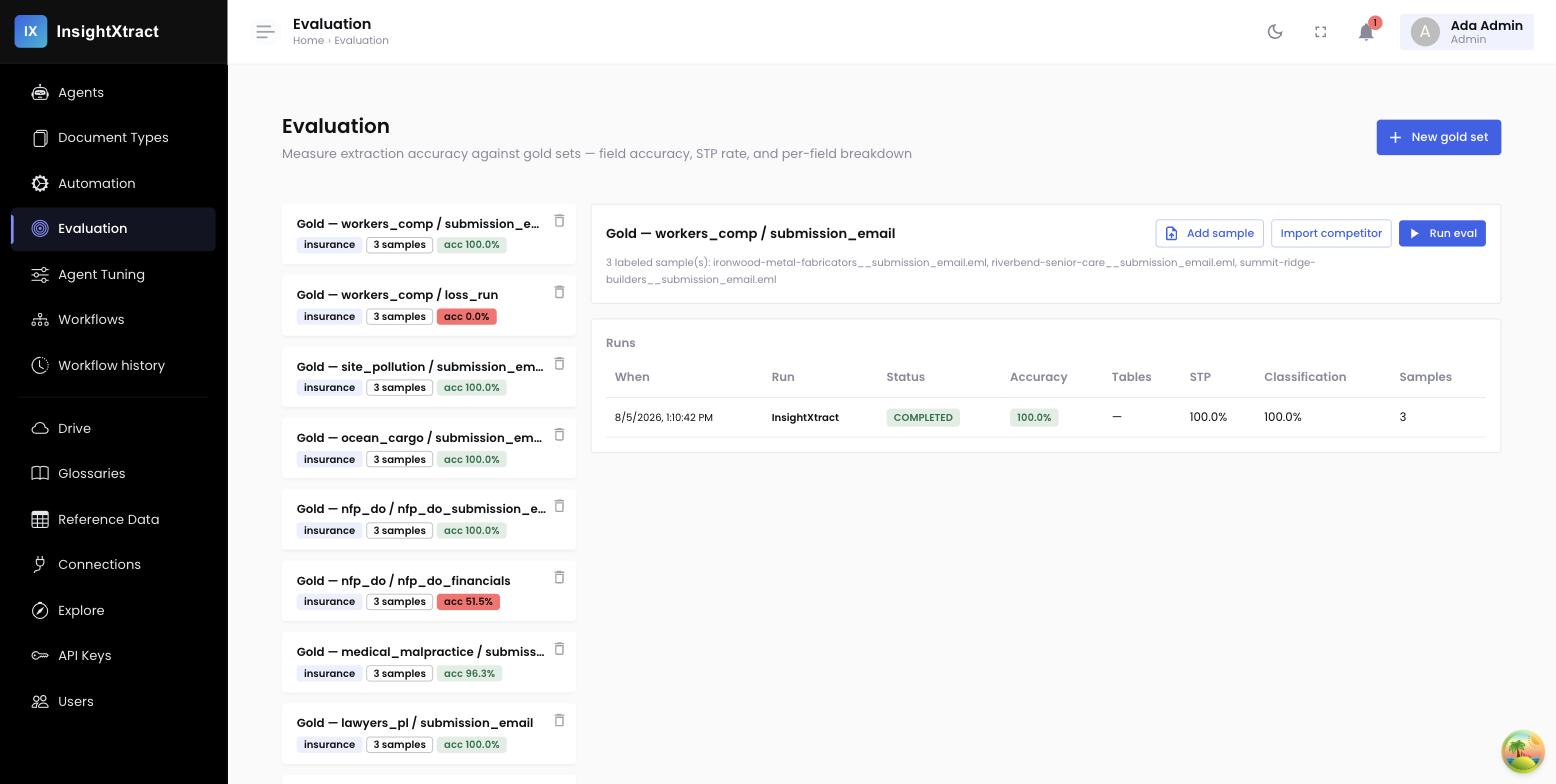
If you skip it: silent errors flow straight into your policy admin or claims system. A transposed limit, a misread FEIN, a loss amount attached to the wrong claimant — each becomes a mispriced risk, a bad reserve, or a coverage dispute discovered months later. You cannot manage what you never measured.
3Autonomy: straight-through rate and calibrated confidence
The objective is very little human involvement — so the metric that governs your ROI is the straight-through rate: the share of documents that reach a validated record with zero human keying. That is only safe if the platform’s confidence scores are well calibrated — a field marked 95% confident should be right about 95% of the time. Calibrated confidence is what lets you set a threshold and auto-accept the clean majority while routing only genuine exceptions to a person.
If you skip it: you get the worst of both worlds. Poorly calibrated confidence means either everything gets reviewed (no labor savings — you automated nothing) or wrong data is auto-accepted with false confidence (you automated your errors). Both destroy the business case.
4Coverage of the real P&C document long tail
P&C intake is not one document; it is a genre. A single submission can carry a broker email, an ACORD 125/126/140, a statement of values, a five-year loss run in Excel, and a supplemental application. Claims add FNOL/loss notices, adjuster and breach-intake emails, incident and medical reports, repair estimates, and demand letters. Bordereaux arrive per-MGA in a dozen shapes. Ask what the platform handles natively across PDF, semi-structured Excel, and free-text email — and how it copes with the endless churn of broker- and MGA-specific templates.
If you skip it: the platform demos beautifully and then fails on the long tail that is 40% of your real volume. Every unsupported template becomes a manual fallback, and the “automated” process quietly reverts to people. Coverage gaps are where automation projects go to die.
5Multi-document consolidation and conflict resolution
Because a submission is many documents, the platform must consolidate them into one record — and decide what wins when they disagree. The insured’s name on the ACORD, the email, and the SOV may differ; the requested limit in the email may not match the application. You need a declared source-of-truth priority (ACORD authoritative over email; endorsement over base) and an entity graph that links insured, policy, locations, vehicles, and claimants across every document rather than treating each file in isolation.
If you skip it: contradictory fields land in your system with no rule for which is right, duplicate entities multiply, and data from a document nobody consolidated simply disappears. Underwriters stop trusting the output and go back to opening the attachments themselves.
6Domain knowledge and validation built in
Generic extractors read text; insurance extractors understand it. The platform should carry P&C reference data — NAICS, SIC, ISO GL class codes, coverage types, state and currency codes — and normalize values against it, flagging codes that don’t exist. On top of that, it should let you encode business rules: totals that must reconcile, dates that must be ordered, limits within appetite, required fields present. Validation is what turns raw extraction into a record safe to auto-accept.
If you skip it: invalid NAICS codes, out-of-appetite risks, and internally inconsistent numbers pass through unchecked, then bounce back from your PAS or your reinsurer — as rework, as a rejected bordereau, or as a pricing error no one caught.
7Human-in-the-loop that is efficient and captured
Minimal human involvement does not mean zero — it means people touch only what genuinely needs judgment, and every touch is captured. Evaluate the reviewer experience: does it surface only low-confidence fields with the source document side-by-side, or force a full re-key? And critically — is every correction, classification fix, approval, and rejection recorded with who, what, and when?
If you skip it: reviewers drown in full-document checks (killing the efficiency you bought), and worse, corrections vanish into the ether — no audit trail for regulators, and no data to make the system better (see next).
8Corrections that make the system smarter — behind a gate
A static model plateaus; a learning one compounds. The platform should turn accumulated human corrections into proposed prompt and rule improvements — but never auto-apply them blind. The right design validates each proposed change against a feedback set and a golden regression baseline, then promotes it as a new, versioned agent only if quality improves and nothing regresses.
If you skip it: either your accuracy never improves — you are re-correcting the same mistakes a year later — or, if the vendor “learns” without a regression gate, an update silently breaks fields that used to work, and you find out from a customer, not a dashboard.
9Auditability, provenance, and versioning — the regulator test
P&C is regulated, and AI-assisted decisions are under growing scrutiny. Apply a simple test: can you explain, reproduce, and defend any single extracted value? That requires per-field provenance (a citation back to the exact page and location), an immutable audit trail of every automated and human action, and versioning of both the agents and the output contract — so you can pin, roll back, and re-run an exact version months later and get the same result.
If you skip it: when an auditor, a market-conduct exam, or a coverage dispute asks “why did the system record this value,” you have no answer. Unpinned model drift means last quarter’s results are not reproducible. In a regulated industry, unexplainable and irreproducible are not inconveniences — they are liabilities.
10Security, governance, and deployment control
Submissions and claims are dense with PII and PHI. Evaluate whether the platform runs inside your perimeter — your cloud (AWS, Azure, GCP, OCI) or on-prem — so documents never leave your control, and whether it offers role-based access with separation of duties (the person who builds an agent should not silently be the person who approves its output). Model choice matters too: can you use the model you trust — Anthropic Claude, OpenAI, or your own — with your own keys, rather than being locked to one provider’s endpoint?
If you skip it: sensitive claimant data transits a third-party SaaS you can’t fully audit, a single role can push an unreviewed change to production, and you inherit a vendor’s model risk and pricing with no exit. Any one of these can stall a deal at security review — or become a breach.
11Integration, automation, and total cost of ownership
Extraction only creates value when the clean record lands in your PAS, claims system, or data lake automatically. Look for a versioned API and SDK, workflow automation, and connectors (SharePoint, S3, email intake) — and the ability to call individual agents from pipelines you already run, without rip-and-replace. Then price it honestly: license is the small part. The real total cost of ownership includes per-document inference cost, review labor, integration effort, and the ongoing maintenance of templates and rules. A platform that lets you control your own cloud and model costs — and onboards new templates by configuration, not a services engagement — is dramatically cheaper to run over three years.
If you skip it: the pilot works but never productionizes because every integration is bespoke glue code; or the sticker price looks low while inference and professional-services bills run away. Projects stall in “pilot purgatory,” and the automated future never arrives.
The criteria at a glance
| Criterion | What breaks if you skip it |
|---|---|
| Genuinely agentic architecture | You buy legacy IDP with an LLM label — brittle, plateaus, retraining per template |
| Field-level accuracy on your data | Silent errors reach your PAS — mispriced risk, bad reserves, disputes |
| Straight-through rate + calibrated confidence | Either no labor savings, or auto-accepted wrong data |
| Coverage of the P&C document long tail | Great demo, manual fallback on 40% of real volume |
| Multi-doc consolidation + conflict rules | Contradictory fields, duplicates, lost data, lost trust |
| Domain knowledge + validation | Invalid codes and inconsistent numbers bounce back as rework |
| Efficient, captured human review | Reviewer overload and no audit / learning signal |
| Learning with a regression gate | Accuracy plateaus, or silent regressions in production |
| Provenance, audit, versioning | Can’t explain, reproduce, or defend a value to a regulator |
| Security, governance, deployment control | PII/PHI exposure, no separation of duties, vendor lock-in |
| Integration + honest TCO | Pilot purgatory or runaway inference and services costs |
How to actually run the evaluation
Turn the rubric into a bake-off you control:
- Bring your own documents. Assemble a blind gold set from real intake — include the messy long tail, not just clean ACORDs. Label the correct answers once.
- Measure the four things that matter: field-level accuracy (precision/recall/F1) per document type, straight-through rate, time-to-record, and cost-per-document — against a manual baseline.
- Test the tail and the churn. Add a broker template the vendor has never seen and see how fast it is production-ready.
- Probe the trust layer. Pick one extracted field and ask the vendor to show its citation, its audit trail, and the exact agent version that produced it — then ask them to reproduce it.
- Model the three-year TCO, including inference, review labor, and template maintenance — not just year-one license.
The through-line
Automating submissions and claims at high accuracy with little human touch is not one feature — it is accuracy you can measure, autonomy you can trust, coverage that holds on the long tail, and governance a regulator will accept, all at a cost you can predict. A platform that is strong on four of those and weak on the fifth will fail exactly where it hurts most.
This is the bar InsightXtract is built to clear: agentic, multi-step extraction purpose-built for Specialty P&C, with per-field provenance, human-in-the-loop that feeds self-improvement behind a regression gate, and deployment in your own cloud with your own choice of model — measured on gold datasets so the accuracy number is real.
Related reading →
Go deeper on two of the criteria above: why provenance and audit trails are non-negotiable in P&C, and where AI should stop and a human should step in.